

Opening your DNA results can feel like unlocking a hidden vault, but small percentages often leave researchers with a specific puzzle: How far back is 2% DNA ethnicity? When you see a small sliver of a distant region on your heritage map, you aren’t just looking at a number; you are looking at a biological ghost from your past.
Understanding how far back is 2% DNA ethnicity requires a blend of genetic science and traditional genealogy. While the math suggests a specific generation, the reality of genetic recombination means your 2% could represent a single distant ancestor or a lingering trace of an even older population. In this guide, we will break down the generational math and show you how to document these findings in your 6-Generation Genealogy Organizer.
1. The Generational Math: How Far Back is 2% DNA Ethnicity?
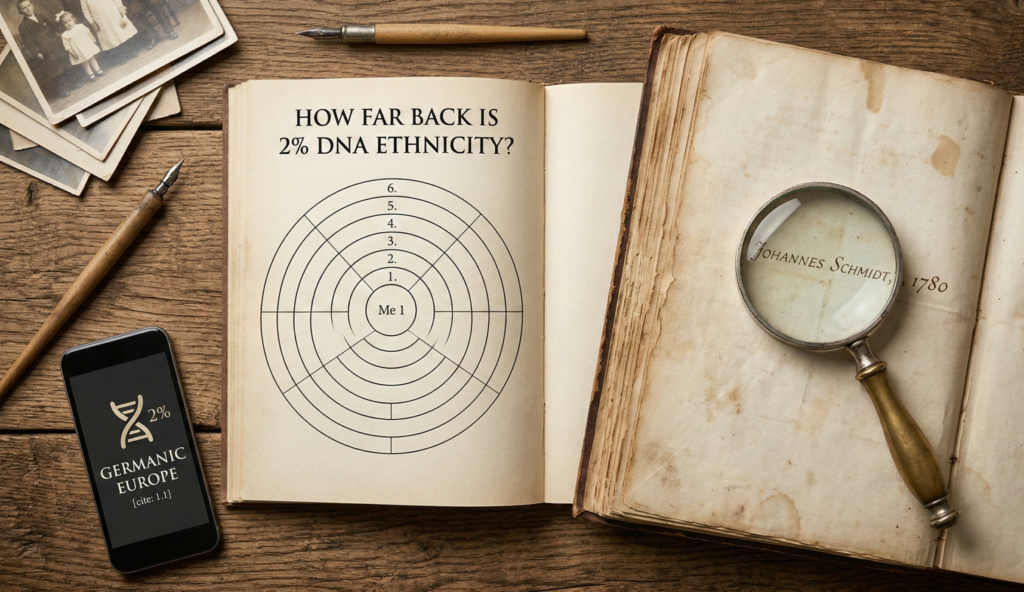
To answer the fundamental question of how far back is 2% DNA ethnicity, we must look at the standard rate of genetic inheritance. On average, a child inherits 50% of their DNA from each parent. As we move backward, those percentages roughly halve with every generation:
- Parents (1st Gen): 50%
- Grandparents (2nd Gen): 25%
- Great-Grandparents (3rd Gen): 12.5%
- 2nd Great-Grandparents (4th Gen): 6.25%
- 3rd Great-Grandparents (5th Gen): 3.125%
- 4th Great-Grandparents (6th Gen): 1.56%
Mathematically, if you are wondering how far back is 2% DNA ethnicity, you are looking at approximately 5 to 6 generations back. This typically identifies a 3rd or 4th great-grandparent who was “100%” of that ethnicity. This timeframe usually places the ancestor in the mid-to-late 1700s or early 1800s.
2. Recombination and the “Roughly” Factor
While the math provides a baseline for how far back is 2% DNA ethnicity, “genetic recombination” is the wild card. You don’t inherit exactly 25% of your DNA from each grandparent; you might inherit 21% from one and 29% from another.
Consequently, a 2% result could actually be from a more distant 5th great-grandparent who passed down a larger-than-average “chunk” of DNA. Conversely, it could be from a closer ancestor from whom you inherited less. This is why tracking your findings in a physical 6-Generation Genealogy Organizer is vital—it allows you to see where the paper trail meets the genetic evidence.
3. Investigating “Noise” vs. Trace Ancestry
When asking how far back is 2% DNA ethnicity, you must consider “statistical noise.” DNA companies like AncestryDNA and 23andMe use reference populations to estimate heritage. If a percentage is very low, it might be a misinterpretation of a DNA segment common across multiple neighboring regions.
However, if that 2% remains consistent across updates or appears in your matches’ results, it is likely legitimate. For help analyzing these segments, tools like DNAPainter help you map which specific ancestor passed that 2% down.
4. Documenting the 2% Mystery in Your Organizer
Once you have a theory about how far back is 2% DNA ethnicity, you must verify it with records. Use the “Notes” and “Source” sections of your 6-Generation Genealogy Organizer to correlate the DNA region with your pedigree chart.
If your DNA shows 2% Scandinavian and your 4th great-grandfather lived in a region known for Viking settlement, you have a lead. By documenting this in a 6-Generation Genealogy Organizer, you can visually see the gaps in your tree where that mysterious ancestor might be hiding.
5. Endogamy: When 2% is a Collective Trace
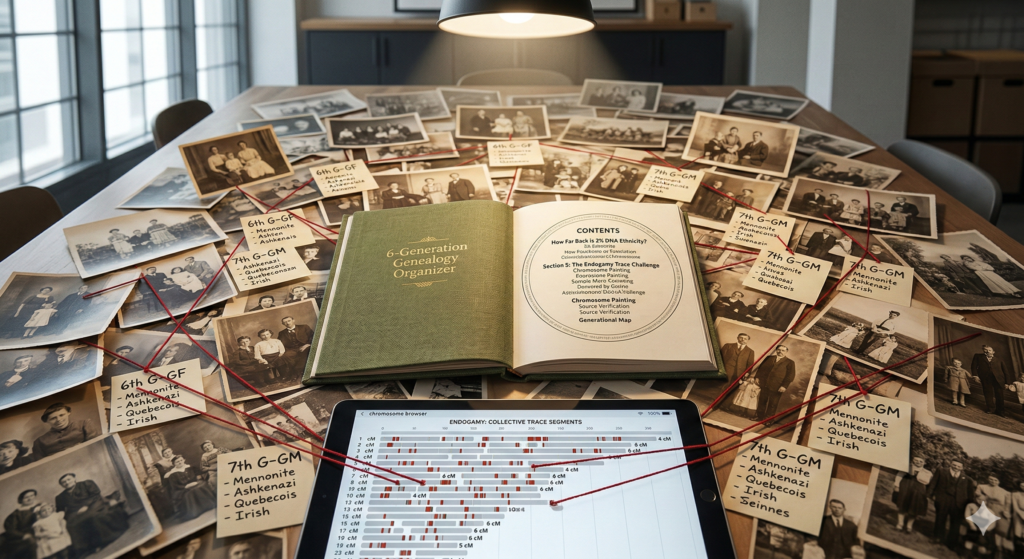
In endogamous cultures—where people married within the same community for centuries—the answer to how far back is 2% DNA ethnicity is more complex. You might inherit dozens of tiny segments of the same ethnicity from many distant ancestors rather than one single person. This can make a 2% result look like it comes from a 3rd great-grandparent when it actually comes from a web of 6th and 7th great-grandparents.
6. The 250-Year Window
For most researchers, the answer to how far back is 2% DNA ethnicity falls within the 250-year window. This is the “sweet spot” of genealogy where records (like the U.S. Census or parish registers) are still available but starting to thin out. Following the golden rule of genealogy—working from the known to the unknown—is the only way to bridge the gap between your 2% result and a specific name on your chart.
7. Success Through Verification
Determining how far back is 2% DNA ethnicity is one of the most exciting challenges in modern genealogy. It represents a bridge to a past that was nearly forgotten. By combining the generational math of the 1800s with modern genetic tools and a structured 6-Generation Genealogy Organizer, you can finally put a name to that elusive 2%.
Don’t let your DNA results sit in a digital cloud. Grab your 6-Generation Genealogy Organizer today and start mapping the 4th and 5th great-grandparents who carry the secrets of your heritage.