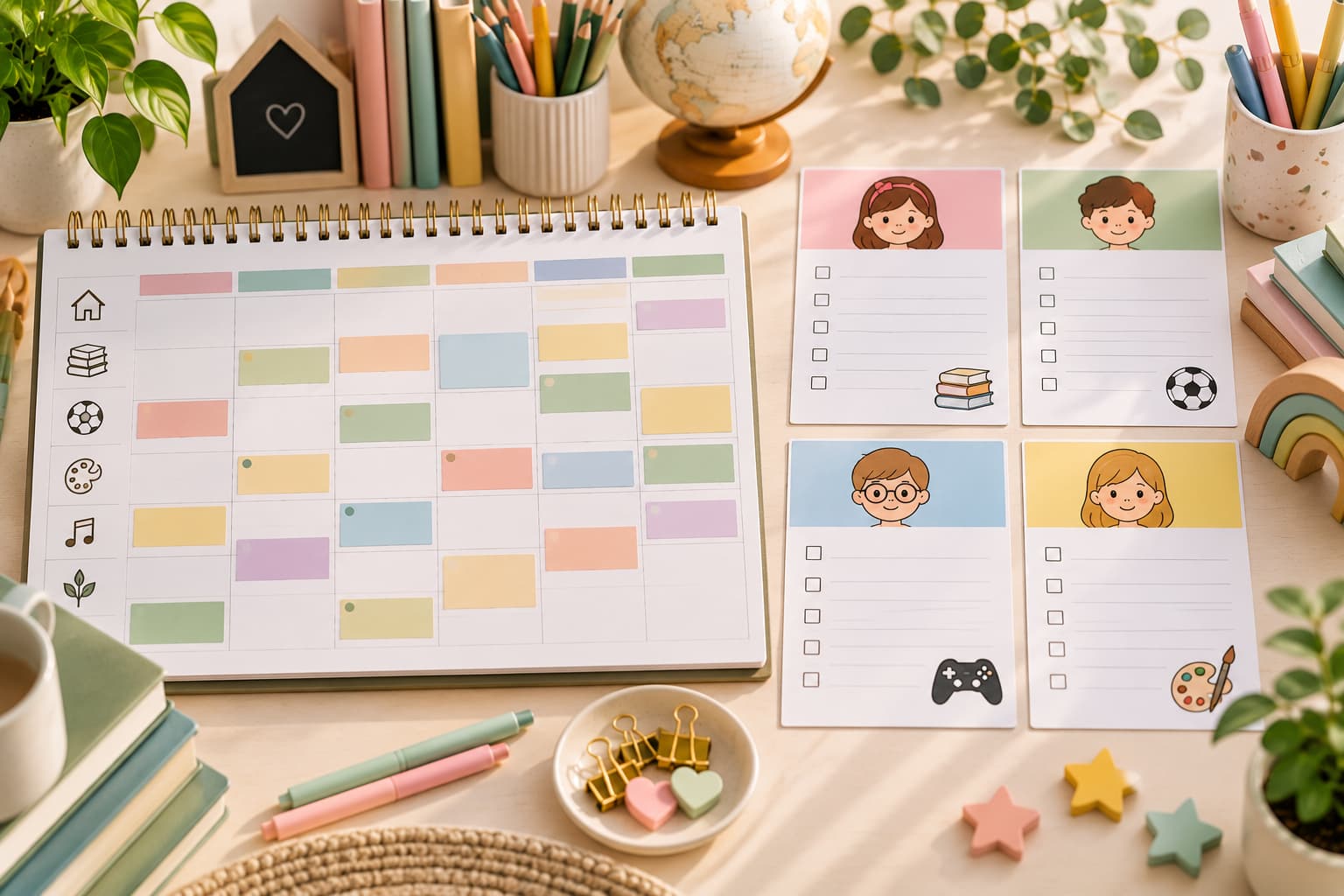
If you are looking for a homeschool planner multiple kids can use, one family planner can be enough. The key is not placing every child on the same page. It is keeping shared family plans together while giving each student a clearly separated place for goals, lessons, progress, and records.
A single planner works best as the family command center. It can show the year, quarter, week, shared activities, and household learning rhythm in one place. Student-specific sections then preserve the details that should not be mixed together, such as curriculum choices, assignments, reading, assessments, and individual objectives.
This structure reduces duplication without pretending that every child learns the same material at the same pace. It also makes it easier to change one student’s plan without rebuilding the schedule for everyone else.
Can One Homeschool Planner Multiple Kids Use Really Work?
Yes, provided that the planner has enough capacity and a clear hierarchy. The family level should hold information everyone shares. The student level should hold information that belongs to one learner. When those two levels are visible, the parent can coordinate the household without losing individual detail.
Problems begin when a planner offers only one generic weekly grid. Writing several subjects for several grades into the same small boxes quickly becomes difficult to read. Color-coding may help for a while, but color alone cannot replace adequate writing space and named student sections.
A practical homeschool planner multiple kids can share should answer two questions at a glance: “What is happening for the family?” and “What does each child need next?” If you must search through loose pages or decode crowded notes every morning, the system is creating work instead of organizing it.
What a Homeschool Planner for Multiple Children Must Separate
The most useful family planning system separates shared planning from individual planning. Shared information can include family learning days, appointments, field trips, library visits, group lessons, holidays, and major deadlines. Writing these items once prevents the same event from being copied into several planners.
Family-level planning
Start with the broadest view. Record the academic year, planned breaks, important dates, quarterly priorities, and recurring family activities. This page is not the place for every worksheet or chapter. Its job is to show the structure around which the individual plans must fit.
A quarterly family view can then connect broad goals with the coming weeks. If everyone studies science together but completes different follow-up work, the shared lesson belongs in the family plan and the different assignments belong in the students’ sections.
Student-specific planning
Each learner needs an identifiable area for profile information, curriculum, annual objectives, resources, supplies, assignments, assessments, projects, reading, and progress notes when those records are relevant. A homeschool planner for multiple children should make these areas easy to find without requiring a different book for every child.
Use the same order for every student section. When Student 1, Student 2, Student 3, and Student 4 follow the same pattern, you know where to record a reading title or find an annual objective. Repetition in structure saves time; repetition in data does not.
Build a Homeschool Schedule for Multiple Kids
A workable homeschool schedule for multiple kids is usually built around shared anchors rather than identical timetables. Anchors may include breakfast, a family read-aloud, a group subject, lunch, outside time, or a quiet-work period. They create a predictable rhythm while leaving room for grade-specific lessons.
Step 1: Mark fixed commitments
Add appointments, co-op meetings, lessons outside the home, work commitments, and other events that cannot move easily. These commitments define the time that remains. Do this before assigning academic tasks so you do not build lessons around hours the family does not actually have.
Step 2: Add shared learning blocks
Place subjects or activities that children can do together into the family schedule. A shared history reading, nature walk, art project, or field trip needs only one family entry. Add student-specific expectations separately when an older learner must write a report and a younger learner will draw or narrate what was learned.
This is where the weekly schedule becomes more efficient: it coordinates shared time without erasing differences in level, pace, or output. The goal is not synchronized worksheets. The goal is a household rhythm that lets each learner know what happens next.
Step 3: Assign independent or one-to-one work
When one child needs direct instruction, decide what the others can do independently. Reading, handwriting, review work, educational audio, or a previously explained assignment may fit that block, depending on age and ability. Do not assume that every “independent” task is actually independent; test the plan and revise it.
Step 4: Leave room for changes
Avoid filling every open hour. Lessons take different amounts of time, younger children may need more help, and a strong interest may deserve extra attention. A flexible family schedule includes buffer space and makes it acceptable to move unfinished work without rewriting the entire week.
Keep Homeschool Record Keeping Separate From Daily Planning
Daily planning answers, “What are we doing next?” Homeschool record keeping answers, “What was planned, completed, assessed, or documented?” The two functions are connected, but they should not compete for the same small box.
Use weekly lesson pages for current work and dedicated logs for information that must remain easy to review later. Attendance, reading, assessments, assignments, projects, field trips, extracurricular activities, and high-school credits may need their own records depending on the student, grade level, and applicable requirements.
Legal requirements are not uniform across the United States. The U.S. Department of Education’s state regulation directory lets families select their state and review information about registration, operation, and other requirements for private and home schools. Before deciding what your homeschool record keeping must include, verify the current rules with your state education agency or other official state authority.
Keep compliance records clear and factual. Do not rely on a commercial planner’s general description as proof that you have met state requirements. A planner can provide useful structure, but the parent remains responsible for identifying which notices, attendance information, evaluations, portfolios, or other documentation applies.
How a Multi Child Homeschool Planner Should Be Organized
A multi child homeschool planner should move from broad family decisions to increasingly specific records. A logical order is year planning, family quarterly planning, student profiles, curriculum and objectives, weekly lesson planning, record-keeping logs, portfolio notes, year-end review, and general notes.
The exact order matters less than predictability. Every section should have a clear purpose, and each repeated student section should use the same labels. Tabs, bookmarks, or simple page flags can make the current week and each student easier to reach.
Use one source of truth
Do not maintain the same assignment in a wall calendar, phone note, weekly planner, and separate notebook unless each copy has a distinct purpose. Choose one place as the authoritative plan. Digital reminders can still handle alerts, while the paper planner holds the fuller family and student context.
Record changes instead of hiding them
Homeschool plans change because children need more practice, move faster than expected, become interested in a related topic, or need a lighter day. Cross out, move, or annotate the plan clearly. A changed plan is useful documentation of what actually happened.
The National Center for Education Statistics homeschooling program collects parent-reported information about subjects, curriculum sources, reasons for homeschooling, and other homeschooling experiences. That range reinforces an important practical point: families use different resources and approaches, so a planning system must be adaptable rather than built around one assumed method.
When One Family Planner Is Not Enough
One planner may not be enough if it lacks space for the number of children, if older students manage their own detailed schedules, or if legal and portfolio documentation is too extensive for one volume. A high-school student may benefit from a personal assignment planner while the family planner continues to hold shared dates and parent records.
You may also need separate subject notebooks, portfolios, or digital files. This does not mean the family planner failed. The planner should coordinate the system, not physically contain every worksheet, essay, certificate, and sample of completed work.
Before buying a multi child homeschool planner, check the stated capacity, page dimensions, calendar span, student sections, writing space, and record types. Look at real interior previews. A cover that says “family planner” does not prove that the inside can keep several learners distinct.
A Homeschool Planner for Multiple Children and Up to Four Students
The Homeschool Family Planner & Record Book is an undated 12-month organizer designed for up to four students. Its 8.5 × 11-inch format combines family planning with separate student information and record-keeping sections, allowing one book to support the household overview and individual learner documentation.
The structure includes year planning, student profiles, curriculum overviews, annual objectives, learning resources, supplies, quarterly family planning, weekly lesson planning, and dedicated records. Those records include attendance, reading, assessments, assignments, projects, field trips, extracurricular activities, and high-school credit tracking.
This homeschool planner for multiple children is most appropriate when a parent wants one central system and has no more than four students to organize. Verify your state requirements separately, then use the relevant sections for your family. You do not need to fill a field merely because it exists.
The planner is designed to reduce the need to maintain separate parent planners for each learner. Individual students may still use their own assignment books when that supports age-appropriate independence.
A Simple Weekly Workflow for One Family Planner
Begin the week by reviewing fixed commitments and the family’s quarterly priorities. Add shared lessons and activities once. Then visit each student section to select the lessons, assignments, and records that matter for that learner.
During the week, mark completed work and note meaningful changes. Do not rewrite the entire plan each evening. At the end of the week, transfer only unfinished work that is still relevant, update any required records, and identify the first priorities for the following week.
This workflow keeps the planning layer active without turning documentation into a nightly reconstruction project. It also creates a visible trail from family goals to individual work and completed records.
Frequently Asked Questions
Can a Homeschool Planner Multiple Kids Share Replace Separate Student Planners?
It can replace separate parent-maintained planners when it provides enough capacity and distinct student sections. Older students may still benefit from personal assignment planners, especially when they are learning to manage deadlines independently.
How Do I Create a Homeschool Schedule for Multiple Kids in Different Grades?
Build the homeschool schedule for multiple kids around fixed commitments and shared learning anchors. Add one-to-one instruction and independent work around those anchors, then keep grade-specific assignments inside each student’s section.
What Should I Check Before Buying?
Confirm the number of supported students, page size, calendar duration, weekly writing space, individual student sections, and included records. Real interior previews are more useful than a general promise that a planner works for families.
One Planner, Clear Family and Student Layers
The right homeschool planner multiple kids can use does not force several learners into one crowded schedule. It gives the family one shared planning center while protecting separate space for each child’s curriculum, lessons, progress, and records.
Start with the family layer, add individual student plans, and keep long-term records in dedicated sections. If the planner can show what everyone shares and what each child needs next, one organized system can replace unnecessary duplication without sacrificing useful detail.