Inheriting a collection of vintage portraits, tintypes, and candid snapshots is a tremendous gift, but the sheer volume often brings an immediate sense of overwhelm. If you look at a stacked dining room table and ask, “What can I do with thousands of old family photos?” you aren’t alone. These images are powerful links to your past, but without structure, they are just deteriorating paper and chemicals.
Understanding what can I do with thousands of old family photos is the first crucial step toward permanent preservation. While it is tempting to start scanning immediately, a rush to digitize can cause you to skip the vital organizational steps that make those digital files useful. In this comprehensive guide, we will provide a clear, professional strategy for managing this heritage and ensuring it complements your 6-Generation Genealogy Organizer.
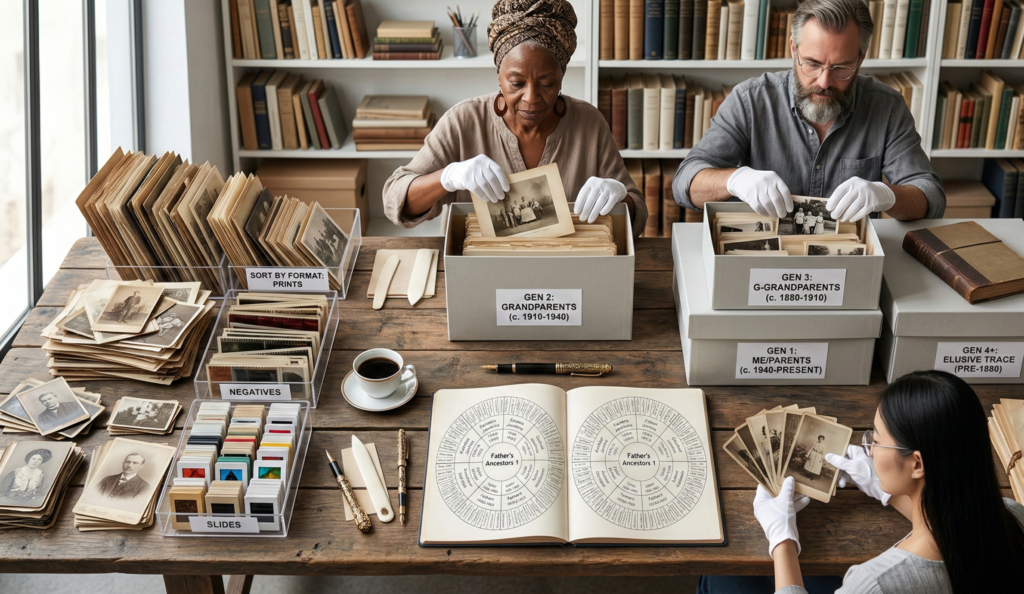
1. Safety First: Establishing an Archival Workflow
Before you can answer what can I do with thousands of old family photos, you must ensure your workflow will not damage them. Historical photographs—especially 19th-century tintypes, ambrotypes, or albumen prints—are highly sensitive.
- Wear Cotton Gloves: Never handle historical photos with bare hands; skin oils can etch into the emulsion, causing permanent damage.
- Maintain the Environment: Work in a clean, climate-controlled space. Photos deteriorate quickly in areas with high humidity or extreme temperature fluctuations (like a garage, attic, or damp basement).
2. Organization by Generation: The Triage Phase
The biggest challenge when asking what can I do with thousands of old family photos is the organizational triage. You must sort your collection efficiently. For professional results, we recommend a hybrid sorting method:
- Sort by Format first: Group your prints, negatives, slides, and non-paper (glass or metal) photos. Different formats require different preservation methods.
- Sort by Chronology/Generation: This is where you connect the photos to your 6-Generation Genealogy Organizer. Start by creating piles for generations: “Me/My Parents,” “Grandparents,” and “Great-Grandparents.”
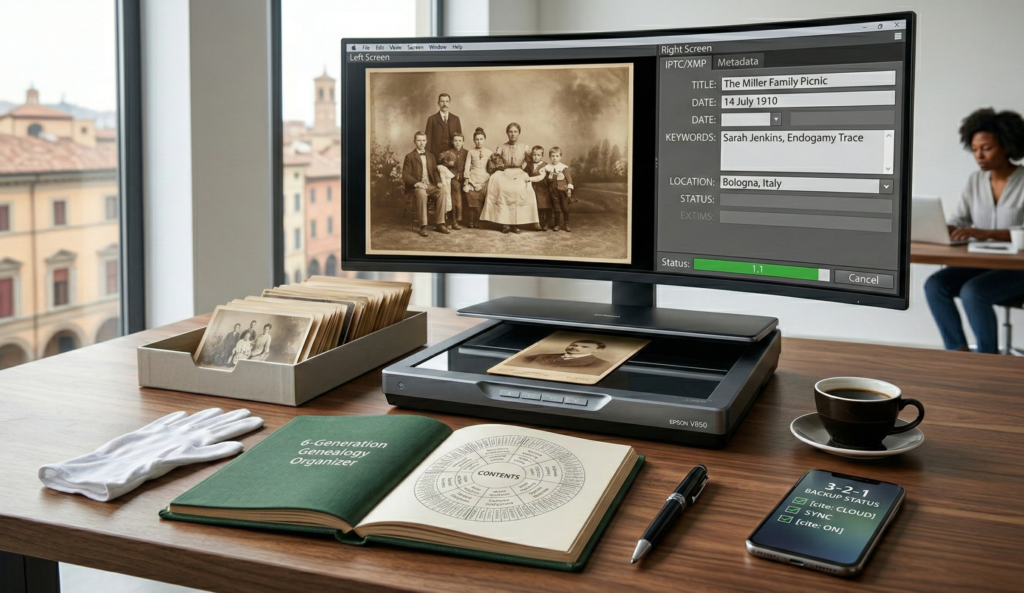
3. High-Resolution Digitization: Building Your Digital Archive
For most researchers, the core answer to what can I do with thousands of old family photos is high-resolution digitization. This is the only path to sharing the heritage without exposing the fragile originals to constant handling.
The Gold Standard: Flatbed Scanning
For bulk collections, a specialized flatbed photo scanner is essential. Do not use an all-in-one office printer; it will not capture the required detail.
- Scan at High Resolution: Scan all original prints at a minimum of 600 DPI (dots per inch) for 1:1 reproduction.
- Save as TIFF Files: Always save your primary master scans as uncompressed TIFF files. Avoid JPEG for your master archive, as JPEG is a “lossy” format that degrades file quality every time it is saved.
4. Metadata: Making Files Searchable
A scanned photo is just a file without context. The critical final step to what can I do with thousands of old family photos is embedding metadata. Modern genealogy software and photo indexing tools use standard data to make photos searchable:
- Who: Identify every individual possible using their full names.
- When: The most accurate date possible.
- Source: Where the photo came from (e.g., ‘From the Estate of Sarah Jenkins’).
5. Physical Storage: Acid-Free Preservation
Once sorted and identified, you must answer what can I do with thousands of old family photos regarding physical storage.
- Archival Storage Boxes: Move all organized, labeled photos into P.A.T. (Photographic Activity Test) certified archival storage boxes.
- Interleaving: Place acid-free, buffered interleaving paper between delicate historical prints or fragile tintypes to prevent sticking or chemical migration.
6. The 3-2-1 Backup Rule
Digital files are fragile in their own way. To truly address what can I do with thousands of old family photos, you must secure the data. Follow the 3-2-1 rule: Keep 3 copies of your data, on 2 different media types (e.g., hard drive and cloud), with 1 copy off-site. This ensures that even a hardware failure won’t erase generations of history.
7. Identifying the “Mystery” Faces
A common hurdle when asking what can I do with thousands of old family photos is unidentifiable subjects. Use modern tools like facial recognition in Google Photos or MyHeritage to group similar faces. Often, seeing the same person at different ages across multiple albums will help you pinpoint which branch of the tree they belong to in your 6-Generation Genealogy Organizer.
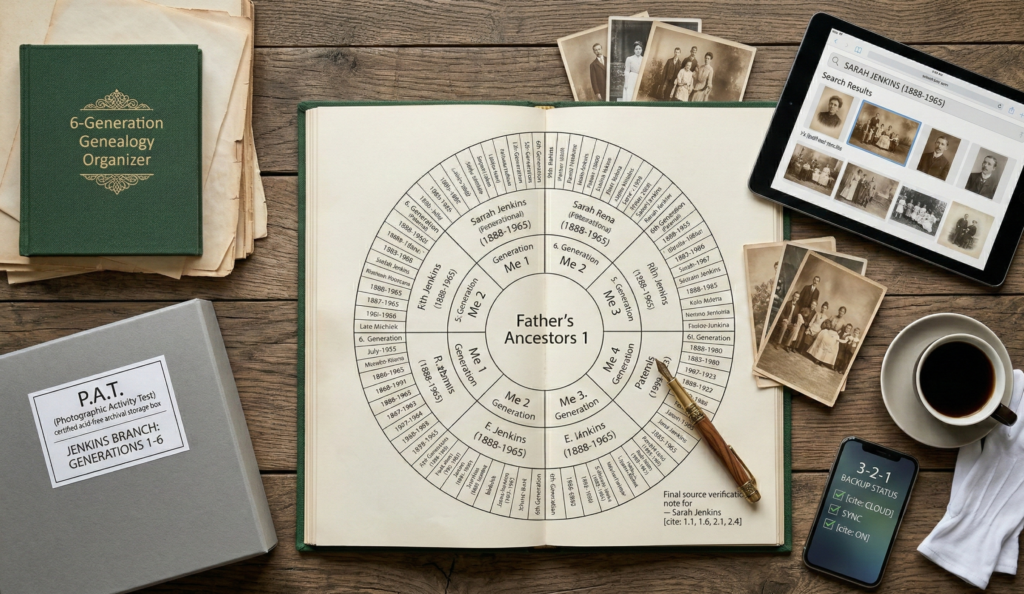
8. The Hybrid Preservation Plan: Digital + Physical
You can’t rely solely on one method. To truly secure thousands of images, you need a hybrid preservation system. Use your 6-Generation Genealogy Organizer to cross-reference your identified photos with verified primary records. While digital images are convenient, they are not permanent—file formats and cloud services change. The physical print, stored under P.A.T. standards, is the only archival constant.
Preservation Starts Today
Don’t let overwhelm paralyze your project. The answer to what can I do with thousands of old family photos is to start organized and work methodically. By following these 8 preservational steps, you are not just managing a collection; you are ensuring your family history is visible, searchable, and permanent for the next six generations.
Ready to secure your research legacy? Grab your 6-Generation Genealogy Organizer to connect your verified family links with your perfectly preserved photos.