System That Reclaims Your Deep Focus and Destroys All Digital Distractions Forever While Building Incredible Discipline And Success To Change Each Small Goal In Your Whole Life Right Now
The Habit Tracker is not just a notebook; it is a sophisticated cognitive architecture designed to facilitate the transition from intention to automaticity. In an era where the average attention span has plummeted to just 47 seconds due to “digital overwhelm,” the resurgence of analog systems highlights a fundamental need for cognitive boundaries . Scientific inquiry into behavioral psychology reveals that approximately 40% of human actions are governed by habits rather than conscious choice . When these habits are managed through digital platforms, they are subject to the “switching cost” of smartphone use, which fragments Focus and degrades the quality of memory encoding .
By contrast, an analog Habit Tracker provides a tactile, distraction-free environment that aligns with the biological mechanisms of the human brain. Recent high-density EEG studies demonstrate that the act of handwriting engages a far more integrated neural network—including the premotor cortex, parietal cortex, and hippocampus—than digital input . This report explores why a physical, non-spiral bound system, loaded with archival features, represents the most scientifically potent method for long-term behavioral change.
What type of habit tracker is the most effective?
The effectiveness of any behavioral intervention is predicated on its ability to satisfy the three components of the Fogg Behavior Model: Motivation, Ability, and a Prompt. A Habit Tracker serves as the central node for these elements, but its physical medium dictates the level of friction involved in the process. Research indicates that the most effective trackers are those that reside in the user’s physical environment, serving as a persistent “spark” or “signal” that cannot be silenced or swiped away.
Analog systems are inherently more effective for Focus because they eliminate the “popcorn brain” effect—a neurological state characterized by the constant expectation of digital novelty . When a tracker is “loaded” with features such as monthly intentions, habit and cycle trackers, and daily reflection sections, it becomes an all-in-one repository for the user’s identity. This integrated approach prevents the fragmentation of Focus that occurs when users “juggle multiple apps” for different life areas.
| Tracking Variable | Analog Habit Tracker | Digital Application |
| Cognitive Friction | Low; always accessible in physical space | High; requires unlocking device and navigating UI |
| Neural Activation | Widespread brain connectivity (EEG verified) | Limited neural activity during passive typing |
| Environmental Cue | Passive visual reminder | Reactive notification (often ignored or swiped) |
| Retention Rate | 42% higher completion with written goals | Susceptible to “app abandonment” |
The Power of Implementation Intentions
A high-performing Habit Tracker facilitates the creation of “Implementation Intentions,” a strategy supported by behavioral scientists like James Clear and BJ Fogg. This involves defining a specific time and location for a behavior, often using a formula such as “After I [Anchor Habit], I will [New Habit]”. In a physical tracker, these intentions are documented by hand, which increases “goal comprehension” and memory retention through the physical tracing of characters. This process creates a “physical trace” in the nervous system, preparing the brain to carry out the future action.
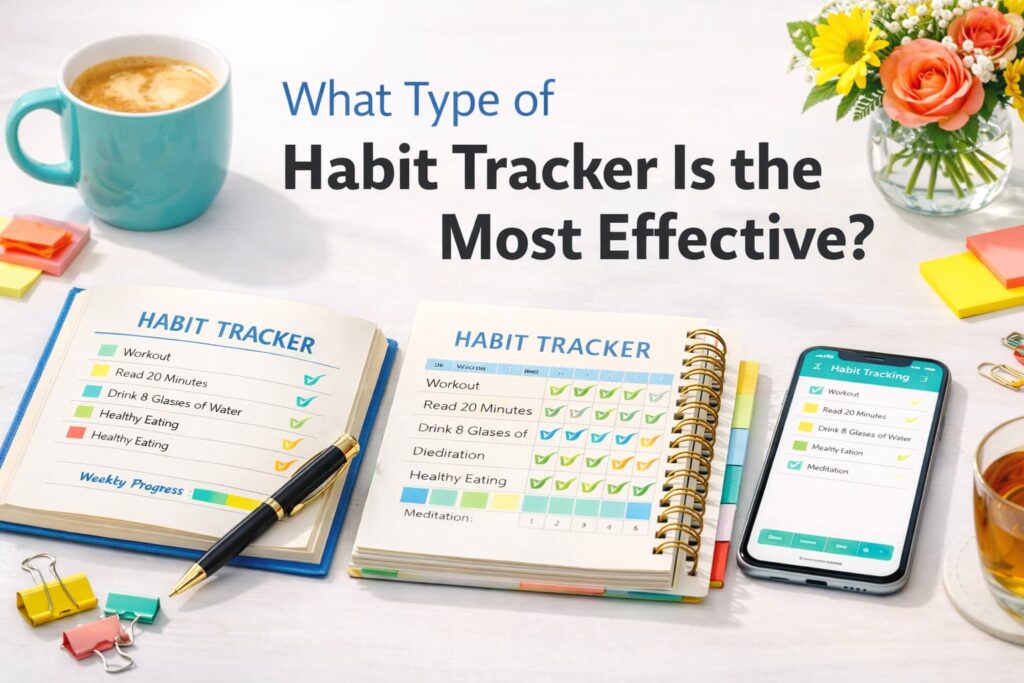
Paper or Digital: Which Habit Tracking Method Works Best?
When comparing tracking mediums, the debate centers on the trade-off between convenience and cognitive depth. Digital apps offer automation and reminders. However, convenience does not necessarily equate to consistency. The analog Habit Tracker succeeds where digital fails by providing a “Focus sanctuary” free from the dopamine loops of the smartphone .
The Neurobiology of Handwriting vs. Typing
A 2024 study using high-density EEG technology provided striking evidence that handwriting increases brain connectivity across regions responsible for memory, movement, and learning . Researchers found that the tactile feedback of the pen on paper creates a “neural symphony” that typing cannot replicate . This connectivity is hypothesized to facilitate the transition of a task from the prefrontal cortex (intentional thought) to the basal ganglia (automatic habit) .
Typing, conversely, relies on repetitive keystrokes that offer limited sensory feedback. This results in more “passive cognitive engagement,” making it easier for the brain to forget the commitment . For users with ADHD, the simplicity and linear nature of a paper tracker are particularly beneficial for maintaining Focus and avoiding “task paralysis”.
Reducing Cognitive Load for Enhanced Focus
The concept of “cognitive offloading” suggests that using digital devices for memory tasks can lead to a decline in internal memory capacity . By writing down habits in a physical system, the user is not just storing data; they are clearing “mental clutter” . This process engages the prefrontal cortex in a way that organizes thoughts and reduces the stress response in the body . Digital apps often add to this cognitive load by presenting complex interfaces, subscription prompts, and irrelevant notifications.

What is the best free tracker app?
While the analog method is superior for behavioral deep-work, many users supplement their routines with digital tools. According to search trends in 2026, the most frequently recommended free apps prioritize simplicity and gamification.
- Loop Habit Tracker app (Android): Recognized as the “gold standard” for open-source tracking. It focuses on long-term trends and “habit strength” scores rather than just streaks.
- Habitica: Ideal for users who respond to RPG-style gamification. It treats real-life habits as “quests,” awarding experience points and in-game items for completion.
- Everyday: A minimal, board-based tracker that emphasizes the “don’t break the chain” philosophy through beautiful color-coded progress visualization.
- Apple Health: A default choice for iOS users to automate health-related tracking such as steps, sleep, and heart rate variability (HRV).
However, even the best free apps are limited by the medium itself. They cannot provide the same “meditative quality” or “stress reduction” found in the rhythm of analog writing .
How it works and more: The Architecture of a “Loaded” Habit Tracker
A “loaded” Habit Tracker is more than a grid; it is a comprehensive productivity ecosystem. To be effective, the inside must be designed with the same care as the cover.20 The absence of a spiral binding is a deliberate choice for Focus, as it ensures a durable, book-like experience that withstands daily use without snagging .
Why this Non-Spiral Bound Habit Tracker Protects Your Focus
Non-spiral, or “bound,” planners offer several ergonomic and psychological advantages over their coiled counterparts:
- Durability and Portability: Bound journals are more resilient during commutes and fit easily into bags without the risk of the spiral bending or snagging on other items .
- Reduced Physical Distraction: For left-handed users, the absence of a center coil eliminates the physical barrier to smooth writing, allowing for uninterrupted thought .
- Lay-Flat Technology: Premium bound trackers use “sewn” or “stitched” bindings that allow the book to lie 180 degrees flat. This provides a stable surface for deep reflection and long-form journaling .
- Archival Integrity: Unlike spirals where pages can tear out over time, a bound tracker keeps your personal history intact, serving as a permanent record of your evolution .
The “Inside-Out” Design Philosophy
A premium Habit Tracker features the following “loaded” interior components:
- Unit Tracking: Space to log specific metrics such as liters of water, workout reps, or pages read, rather than simple checkmarks.
- Flexible Cadences: Dedicated sections for daily, weekly, and monthly reviews to identify patterns and “plateaus of latent potential”.
- Visual Dashboards: Progress-at-a-glance grids and motivational wallpapers that turn dry data into “motivational stories”.
- Reward Systems: Integrated positive reinforcement sections that encourage users to celebrate small wins, a practice pioneered by BJ Fogg .

Superior Paper Quality and the “QuillEase™” Experience
For a Habit Tracker to be used consistently, the paper must provide a pleasurable tactile experience. This requires a high GSM (Grams per Square Meter), typically 160 GSM for a truly “loaded” experience .
| Paper Weight | Performance Characteristics | Suitability |
| 80-100 GSM | Thin; prone to “ghosting” and ink bleed | Standard notebooks; not for heavy ink users |
| 120 GSM | Premium; handles gel and fountain pens with minimal show-through | Excellent for everyday habit logging |
| 160 GSM | Heavy-duty; cardstock-like feel; zero bleed-through | Ideal for Deep Focus and artistic tracking |
The use of acid-free, archival paper ensures that your progress records do not yellow or become brittle, allowing the tracker to serve as a permanent record of personal evolution .
Reclaim Your Focus with Habit Stacking
One of the most powerful ways to build a new behavior is to identify a current habit you already do each day and then stack your new behavior on top . This technique, popularized by James Clear, leverages the “synaptic pruning” of the adult brain to create faster, more efficient neural connections .
The Habit Stacking Formula:
“After I, I will.”
- Example: “After I pour my morning coffee, I will open my Habit Tracker and plan my top 3 focus tasks”.
- Example: “After I close my work laptop, I will mark my meditation habit for the day”.
By using an analog tool, the tracker itself becomes the physical “cue” in your environment, further reducing the reliance on fluctuating levels of motivation .
Designing Your Environment for Maximum Focus
Your environment is the “invisible hand” that shapes human behavior. To ensure your Habit Tracker becomes a mainstay of your routine, you must design your surroundings to support it:
- Visual Prominence: Place your tracker where you cannot ignore it—on your nightstand, desk, or next to your coffee machine.
- Reduce Friction: Keep a high-quality pen attached to or resting on the current page of your tracker so there is zero delay in logging.
- The “Never Miss Twice” Principle: If you fall off track, don’t spiral into shame. Prioritize getting back to the habit immediately to protect the neural pathway .
The Science of Focus and Neuroplasticity
Focus is not a talent; it is a structure . Engaging in handwriting daily is a form of “neuroscientific strategy” that constructs the very architecture of thought . For individuals with ADHD, habit tracking on paper provides a “dopamine anchor”—a healthy, earned reward that reinforces the basal ganglia without the addictive “hit” of a smartphone screen .
By documenting small wins, you recalibrate your dopamine sensitivity, making it easier to concentrate on long-term objectives and “deep work” sessions . Research from the University of South Australia suggests that while it takes an average of 66 days to form a habit, the visual feedback from a tracker keeps you motivated during the “Valley of Disappointment” .
7 Reasons This Habit Tracker Outperforms Digital Apps
- Deep Brain Activation: Handwriting generates widespread theta and alpha activity, brain rhythms associated with learning and memory consolidation .
- No Notification Interruptions: The analog medium eliminates the risk of “app-switching” and “task-switching” costs that drain your cognitive energy .
- Physical Memory Encoding: The motor movements of writing create a “physical trace” that the brain treats as evidence of commitment .
- Archival Longevity: Archival, 160 GSM paper preserves your history for years, unlike digital data which is subject to cloud failures or deletions .
- Tactile Satisfaction: The rhythm of the pen on textured paper provides a meditative quality that reduces stress and clears mental clutter .
- Identity-Based Change: A physical tracker serves as a “voting booth” where every mark is a vote for the person you are becoming .
- Environmental Cueing: A physical tracker acts as a persistent visual prompt that apps hidden behind a lock screen cannot replicate.
Conclusions and Recommendations
The transition from digital to analog habit tracking is a strategic decision to prioritize Focus and long-term cognitive health. The evidence provided by recent EEG studies and behavioral frameworks consistently points toward the superiority of handwriting on high-quality, archival paper .
Actionable Advice for Your Habit Journey
- Invest in 160 GSM Paper: Ensure a smooth, bleed-resistant experience that makes you want to return to the page .
- Start Insanely Small: Use the “Two-Minute Rule”—scale your habit down until it feels laughably easy to perform .
- Perform a Weekly Review: Use the “loaded” reflection pages to analyze your patterns and adjust your strategy for the coming week.
For more insights on reclaiming your Focus, visit our or browse our(https://example.com/habit-tracking-templates). Detailed academic studies on dopamine and habit learning are also available via PMC PubMed and authoritative resources like James Clear’s Habit Guide.

Leave a Reply