Living with ADHD often feels like having a thousand browser tabs open at once, all playing different videos at full volume. The constant hum of hyperactivity, the weight of executive dysfunction, and the sting of sensory overload can make finding a moment of peace feel nearly impossible. However, there is a gentle solution gaining popularity in the neurodivergent community. This mindful coloring guide is designed to help you navigate the chaos of an ADHD brain and find a sanctuary in the simple act of putting pencil to paper.
For many adults, the concept of “mindfulness” can feel inaccessible. Sitting still in traditional meditation often leads to restless legs and a wandering mind. This is where slow living activities like calming coloring come into play. By engaging the hands and the eyes, we provide the ADHD brain with just enough stimulation to keep it occupied, allowing the deeper, more anxious parts of the mind to finally rest. In this comprehensive stress relief coloring guide, we will explore how you can turn a childhood pastime into a powerful therapeutic tool for emotional regulation and focus.
What Exactly is Mindful Coloring?
Mindful coloring isn’t about creating a masterpiece or staying perfectly within the lines. It is a form of active meditation. Unlike traditional coloring, where the goal might be to finish a page or create something “pretty,” calming coloring focuses entirely on the process. It is about the sensation of the pencil moving against the paper, the vibrancy of the colors, and the rhythm of your breath as you fill in each shape.
According to Psychology Today, mindfulness is the psychologically healthy state of being fully present in the moment. For someone with ADHD, this presence is often elusive. Our minds are usually five steps ahead, worrying about tomorrow’s deadlines, or three steps behind, ruminating on a social awkwardness from three years ago. A structured mindful guide helps anchor you to the “now.”
Why This Coloring Guide is a Game-Changer for ADHD Brains
The ADHD brain thrives on dopamine, the neurotransmitter responsible for motivation and reward. Many of the tasks we face in adulthood—answering emails, doing laundry, or filling out spreadsheets—are “low-dopamine” tasks. They feel physically painful to start. Coloring, however, provides immediate visual feedback. Each stroke adds color and progress, providing small, frequent hits of dopamine that keep the ADHD brain engaged without overstimulating it.
The Science of ADHD and Sensory Input
Neurodivergent individuals often experience sensory processing differences. Sometimes the world is too loud, too bright, or too fast. Engaging in slow living activities allows you to control your sensory environment. When you use the high-quality, thick-paper books from Medeea Publishing, you are engaging in a tactile experience that can be incredibly grounding. The “scritch-scratch” sound of a colored pencil and the smooth texture of the page act as a form of “stimming” (self-stimulatory behavior) that helps regulate the nervous system.
Embracing Slow Living Activities to Combat Overwhelm
The “Slow Living” movement is about intentionality. It is about rejecting the cult of busyness and choosing quality over quantity. For an ADHD adult, slow living is a radical act of self-care. It means giving yourself permission to do something that has no “productive” value other than your own well-being. This mindful coloring guide encourages you to view calming coloring not as a waste of time, but as a vital part of your mental health toolkit.
The 7-Step Coloring Guide for Maximum Relaxation
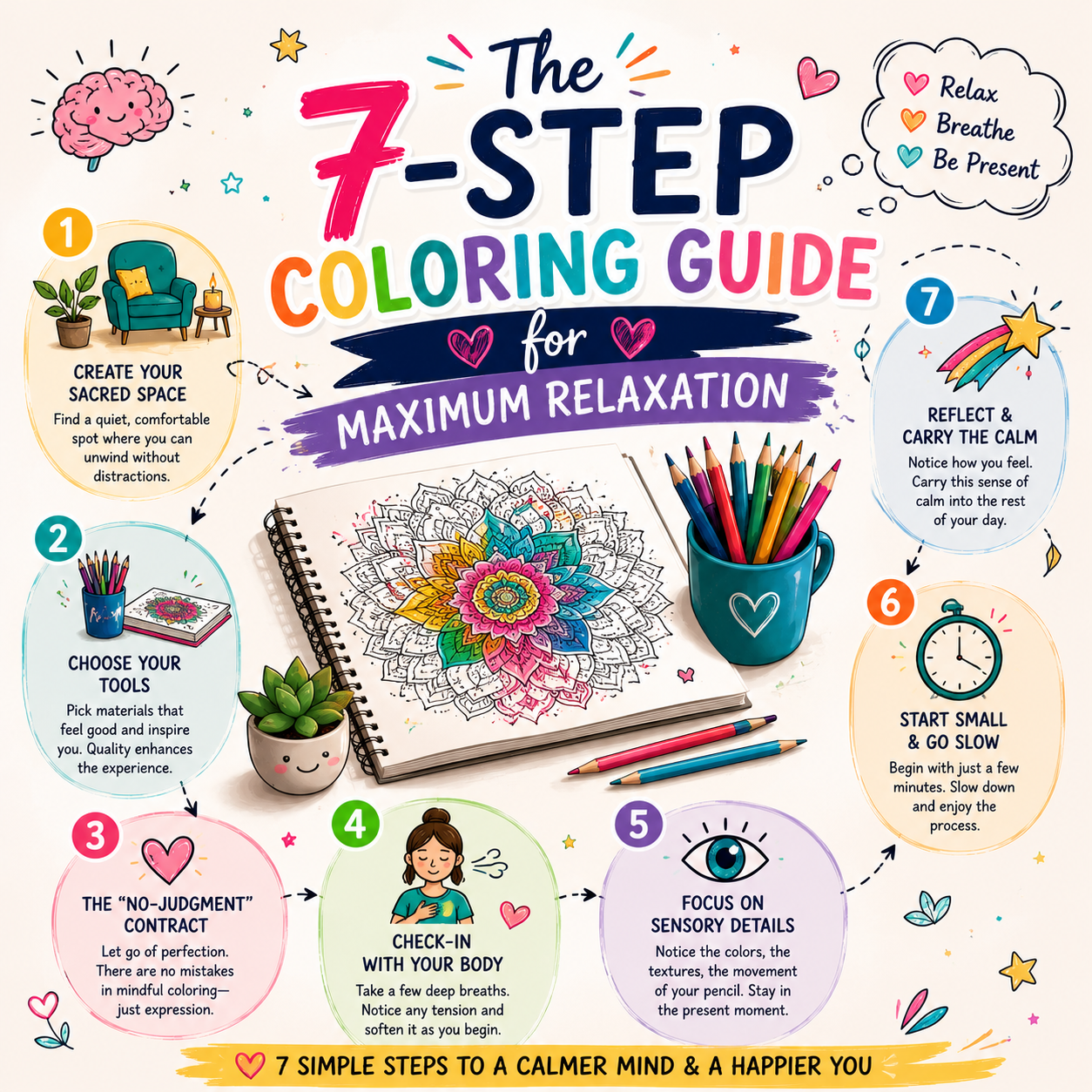
Step 1: Create Your Sacred Space
The ADHD brain is highly sensitive to its environment. If you try to color at a cluttered desk surrounded by unpaid bills, your mind will drift to those stressors. Find a space that feels safe. Clear away the clutter. Perhaps light a candle or put on some lo-fi beats or nature sounds. The goal is to signal to your brain that “work time” is over and “healing time” has begun.
Step 2: Choose Your Tools with Intention
Not all calming coloring materials are created equal. For a truly mindful experience, the texture matters. This is why many in the community prefer our Medeea Publishing coloring books. Our books are specifically designed with intricate patterns that challenge the ADHD mind just enough to prevent boredom, but not so much that they cause frustration. Whether you prefer soft-core colored pencils, fine-liner markers, or even watercolor brushes, choose tools that feel good in your hand.
Step 3: The “No-Judgment” Internal Contract
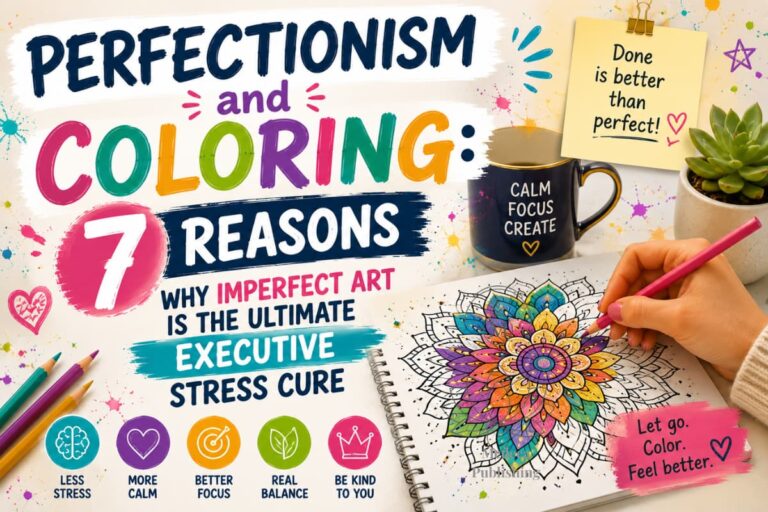
Before you touch the paper, make a pact with yourself. This is the most critical part of this stress relief coloring guide. ADHD adults often struggle with “Rejection Sensitive Dysphoria” (RSD) and perfectionism. You might feel the urge to rip out a page if you “ruin” it with the wrong color. Stop. Remind yourself that there are no mistakes in mindful coloring. If a color looks “wrong,” explore that feeling. Why does it feel wrong? Can you lean into the “imperfection”?
Step 4: Check-In With Your Body
Before you start, take three deep breaths. Notice where you are holding tension. Are your shoulders up to your ears? Is your jaw clenched? As you begin to color, try to coordinate your movements with your breath. Inhale as you pick up a pencil; exhale as you fill in a small section. This connection between the body and the action is the core of mindfulness.
Step 5: Focus on the Sensory Details
As you color, engage your senses. Notice the way the pigment covers the white of the paper. Observe the transition of colors if you are blending. Feel the weight of the book. If your mind wanders (and it will, because you have an ADHD brain), gently acknowledge the thought and then bring your focus back to the sensation of the pencil. This “returning to the center” is the “bicep curl” of mindfulness.
Step 6: Use Color to Express, Not Just Decorate
Don’t feel restricted by reality. If you want to color a tree purple because you feel a sense of mystery today, do it. Use the colors to mirror your internal state. Using a mindful coloring guide isn’t about following rules; it’s about finding a language for your emotions when words feel too heavy or complicated.
Step 7: Reflect Without Critique
When you decide to stop—whether you finished the page or just a small corner—take a moment to look at what you’ve done. Don’t look for mistakes. Look at the energy of the page. Do you feel calmer? Is your heart rate lower? Gratitude for the time you spent on yourself is a powerful way to end the session.
The Benefits of Using a Coloring Guide for Anxiety Relief
The Mayo Clinic notes that creative activities can significantly lower cortisol levels. For ADHD adults, anxiety is often a constant companion. The repetitive nature of coloring helps to “unplug” the amygdala—the brain’s fear center. When you are focused on the intricate details of a Medeea Publishing design, your brain can’t simultaneously maintain a high-alert stress response.
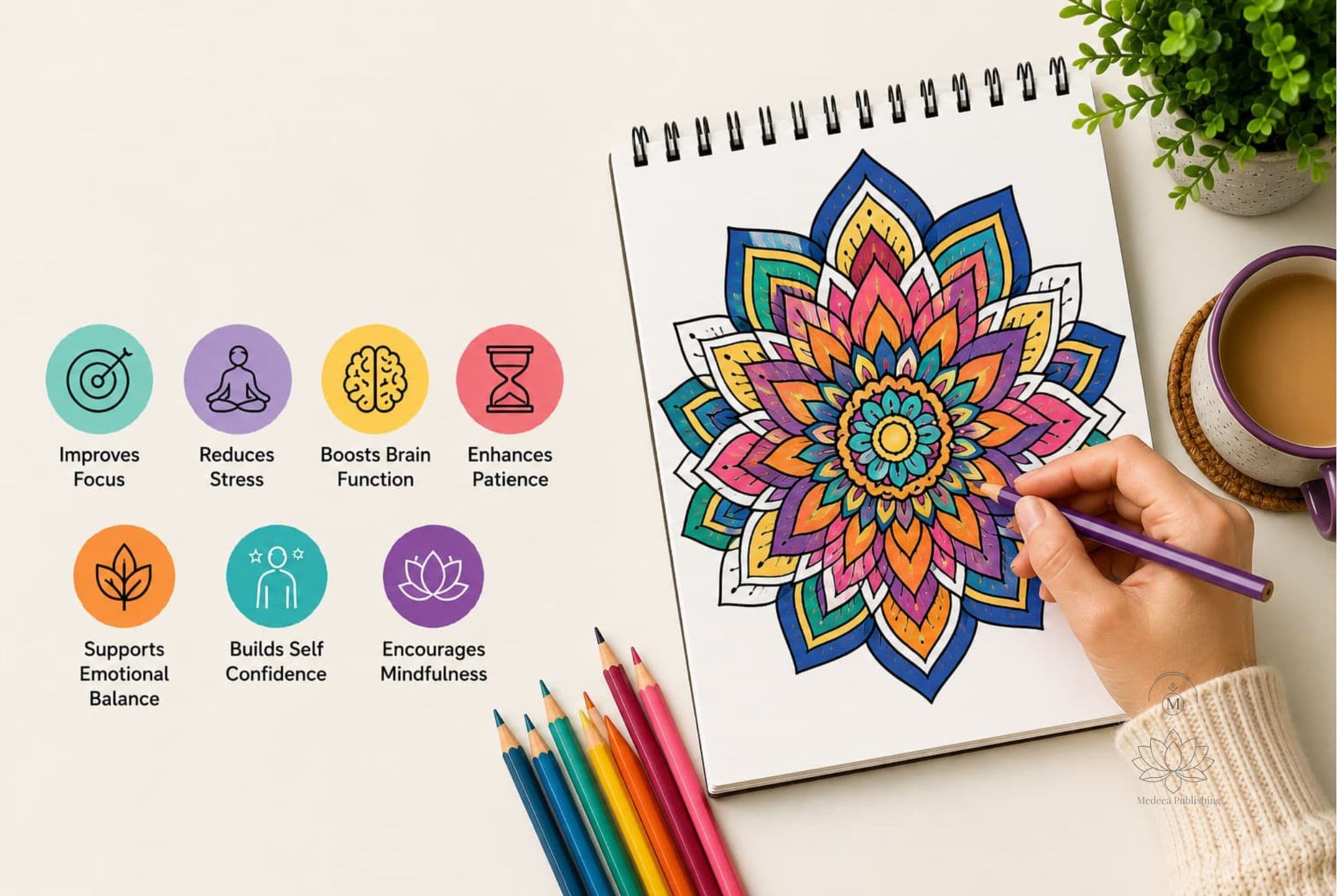
Furthermore, this guide can help improve your “focus stamina.” ADHD is not a lack of focus, but rather a difficulty in directing it. By practicing focus on a low-stakes activity like coloring, you are training your brain to sustain attention, which can eventually carry over into other areas of your life.
Overcoming Common ADHD Obstacles to Mindfulness
The “Boredom” Wall
Many ADHD adults start a project with high enthusiasm only to lose interest ten minutes later. If you find yourself getting bored, change your technique. Switch from colored pencils to markers. Move from a large section to a tiny, detailed one. Remember, the guide is a flexible framework, not a rigid set of laws.
The “Perfectionist” Trap
If you find yourself paralyzed by the fear of “messing up” a beautiful book, try starting with a “test page” or use a palette of only three colors. Limiting choices can actually reduce the executive function load, making it easier to start. Medeea Publishing’s books offer a variety of complexity levels, so you can choose a page that matches your current energy level.
The “I Don’t Have Time” Excuse
Mindful coloring doesn’t require hours. Even five minutes of intentional coloring can reset your nervous system. Think of it as a “micro-break” for your brain. Incorporating these slow living activities into your daily routine—perhaps right after work to transition into “home mode”—can make a massive difference in your overall stress levels.
Why Medeea Publishing is the Perfect Partner for Your Journey
At Medeea Publishing, we understand the neurodivergent experience. We don’t just make “coloring books”; we create tools for emotional regulation. Our designs are curated to provide the perfect balance of complexity and flow. When you follow this mindful coloring guide using our collections, you are investing in high-quality paper that won’t bleed through, allowing you to use whatever medium makes your brain happy.
Our community often tells us that our books are the only thing that can “quiet the noise” after a long day. Whether you are dealing with a stressful job, the sensory demands of parenting, or the general “loudness” of the world, our books provide a quiet corner for your soul. We believe that slow living activities are the antidote to the modern world’s chaos.
Integrating Mindfulness into an ADHD Lifestyle
A guide is just the beginning. Once you experience the peace that comes from active meditation, you might find yourself looking for other ways to slow down. This might include:
- Mindful Walking: Paying attention to the feel of your feet on the ground.
- Sensory Cooking: Focusing on the smells and textures of your ingredients.
- Digital Detox: Setting specific times to put away the “dopamine machines” (phones) and engage with the physical world.
Advanced Techniques in Mindful Coloring
Once you are comfortable with the basics of this stress relief coloring guide, you can experiment with more advanced psychological techniques:
Coloring for Mood Regulation
If you are feeling angry or frustrated, use high-contrast colors and sharp, bold strokes. Let the paper absorb that energy. If you are feeling anxious, use cool blues and greens with soft, circular motions. This “somatic” approach to coloring helps process emotions through movement.
Combining Affirmations with Coloring
As you fill in a design, repeat a simple mantra in your head. Something like “I am present,” “I am enough,” or “My brain is a gift.” Associating these positive thoughts with the relaxing physical act of coloring helps “wire” them into your brain more effectively.
Conclusion: Your Journey to a Calmer Mind
ADHD is a journey of constant adaptation. It requires us to find creative ways to live in a world that wasn’t necessarily built for our brain types. This mindful coloring guide offers a bridge between the hyper-speed of the ADHD mind and the tranquility of the present moment. By engaging in slow living activities, you aren’t just “coloring”; you are practicing the art of being alive, one stroke at a time.
We invite you to explore our full range of therapeutic tools at Medeea Publishing. Take the first step toward a more mindful, peaceful life today. Pick up a pencil, open a book, and let the rest of the world fade away. Your brain deserves the break.
Final Thoughts for the ADHD Soul
Remember, your worth is not measured by your productivity. You are allowed to take up space. You are allowed to spend time on things that bring you joy. This stress relief coloring guide is your permission slip to slow down. The colors are waiting for you.
Summary of the Stress Relief Coloring Guide for Quick Reference:
- Environment: Minimize distractions to help the ADHD brain settle.
- Supplies: Choose high-quality materials from Medeea Publishing for a better sensory experience.
- Mindset: Release the need for perfection; embrace the process of slow living activities.
- Breath: Sync your coloring strokes with your inhalation and exhalation.
- Senses: Stay grounded by focusing on the tactile and visual details.
- Expression: Use color as a mirror for your internal emotions.
- Gratitude: End your session with a positive reflection on the time spent.
By following this stress relief coloring guide, you are building a more resilient, focused, and calm version of yourself. Happy coloring!
Frequently Asked Questions
What is a Mindful Coloring Guide for ADHD adults in practice?
A Mindful Coloring Guide is not just “coloring slowly.” It is a step-by-step method that replaces chaotic thinking with structured sensory focus. For ADHD adults, it works because it combines movement (hand), stimulation (color), and repetition (patterns). This prevents distraction while anchoring attention in the present moment.
Why does stress relief coloring reduce mental overload so quickly?
Stress relief coloring reduces overload because it shifts brain activity away from the amygdala (stress response) toward visual-motor processing. When you focus on filling shapes and choosing colors, your brain cannot maintain high anxiety at the same time. This creates a fast, noticeable drop in tension.
How is calming coloring different from regular coloring?
Calming coloring is process-focused, not result-focused. Regular coloring aims for a finished page. Calming coloring focuses on:
- repetitive motion
- sensory feedback (texture, sound)
- controlled attention
This difference is critical for ADHD, where the goal is regulation, not perfection.
Why are slow living activities essential for ADHD recovery?
Slow living activities reduce cognitive overload by limiting inputs and forcing intentional action. ADHD brains struggle with constant stimulation. Activities like coloring create a controlled environment where:
- decisions are simple
- pace is slow
- feedback is immediate
This stabilizes attention and lowers emotional volatility.
How does a Mindful Coloring Guide improve focus over time?
Using a Mindful Coloring Guide trains “attention endurance.” ADHD is not lack of focus — it’s unstable focus. Coloring builds:
- sustained attention (staying on one task)
- task completion tolerance
- reduced impulsive switching
Over time, this transfers to work, reading, and daily responsibilities.
Why do materials matter in stress relief coloring?
In stress relief coloring, poor materials break the experience. Thin paper, weak outlines, or low-quality print create friction. High-quality materials:
- provide consistent sensory feedback
- reduce frustration
- allow smooth repetitive motion
This is why structured books (like Medeea Publishing) increase effectiveness.
Can calming coloring help with emotional regulation, not just relaxation?
Yes. Calming coloring is not only relaxing — it is a regulation tool. By choosing colors and controlling motion, you process internal states without verbalizing them. For example:
- chaotic coloring = release tension
- slow, repetitive coloring = stabilize anxiety
It becomes a non-verbal system for emotional control.