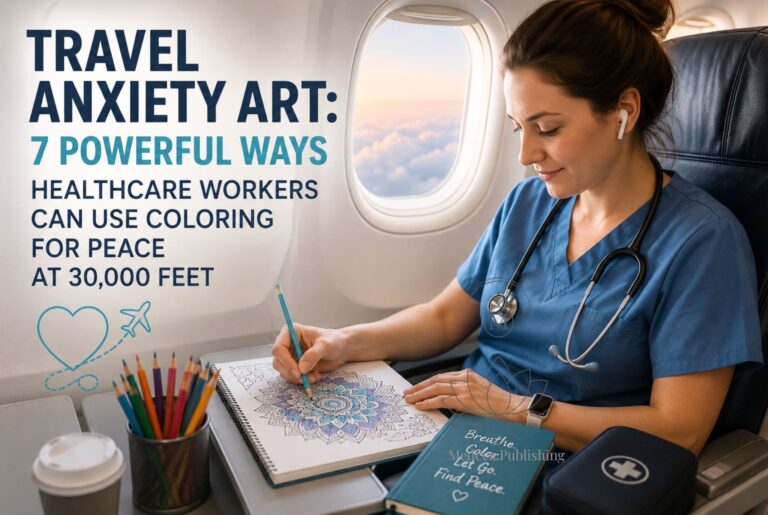
For an athlete, the world is defined by motion. Your body is a finely tuned machine, used to the rhythmic pounding of pavement, the explosive power of a jump, or the precision of a calculated strike. However, when injury strikes or the off-season demands a slower pace, that internal engine doesn’t just shut off. It idles high. This is particularly evident during air travel. For many recovering athletes, the confined space of an airplane cabin can trigger a unique form of restlessness that borders on panic. Fortunately, travel anxiety art has emerged as a transformative tool to channel that stagnant energy into something restorative.
Transitioning from a life of high-octane physical activity to the forced stillness of a recovery phase is mentally taxing. When you add the sensory overload of an airport—the crowds, the noise, and the pressurized cabin—it’s easy for anxiety to take hold. You are used to “working through the pain,” but flight anxiety isn’t something you can outrun on a treadmill. It requires a different set of mental clarity exercises. By engaging in travel anxiety art, specifically through the intricate world of adult coloring, you can hijack your brain’s stress response and return to a state of competitive calm.
In this comprehensive guide, we will explore why coloring is the ultimate “active recovery” for your mind, how to implement it during your next flight, and why Medeea Publishing offers the specific tools you need to maintain your mental edge while your body heals.
Understanding the Athlete’s Mind: Why Planes Trigger Stress
Athletes thrive on autonomy and movement. On a plane, both are taken away. You are strapped into a seat, told when to eat, and forced to remain still for hours. For someone in recovery, this lack of control can mirror the frustration of being sidelined by an injury. This is where travel anxiety art becomes more than just a hobby; it becomes a psychological anchor.
When you engage in travel anxiety art, you are reclaiming a sense of agency. You decide the palette, the pressure of the pencil, and the pace of the progress. This mimics the “micro-goals” athletes set during physical therapy. According to research on the power of creative expression, focusing on a repetitive, creative task can significantly lower cortisol levels, which are often elevated in athletes who are unable to burn off stress through traditional exercise.
The Science of Travel Anxiety Art and Mental Recovery
Why does coloring work so well for those used to the locker room rather than the art studio? It’s all about the “Flow State.” Athletes know this state as “the zone.” It is that magical moment where the challenge of the task perfectly matches your skill level, and the rest of the world fades away. Travel anxiety art is a shortcut to the zone when your body can’t get you there.
When you open a Medeea Publishing coloring book, your brain begins to shift from the “fight or flight” sympathetic nervous system to the “rest and digest” parasympathetic nervous system. This transition is crucial for recovering athletes. Healing happens faster when the body is not in a state of chronic stress. By practicing travel anxiety art, you are literally creating a chemical environment in your body that facilitates faster tissue repair and mental rejuvenation.
Mental Clarity Exercises for the High-Performance Mind
Coloring should be viewed as one of several mental clarity exercises available to the modern athlete. Just as you wouldn’t go into a game without a warm-up, you shouldn’t board a plane without a mental strategy. Combining coloring with deep diaphragmatic breathing creates a synergistic effect. As you fill in a complex geometric pattern, focus on inhaling for four counts and exhaling for six. This pairing of somatic and cognitive engagement is a gold standard in sports psychology.
7 Ways Travel Anxiety Art Heals the Recovering Athlete
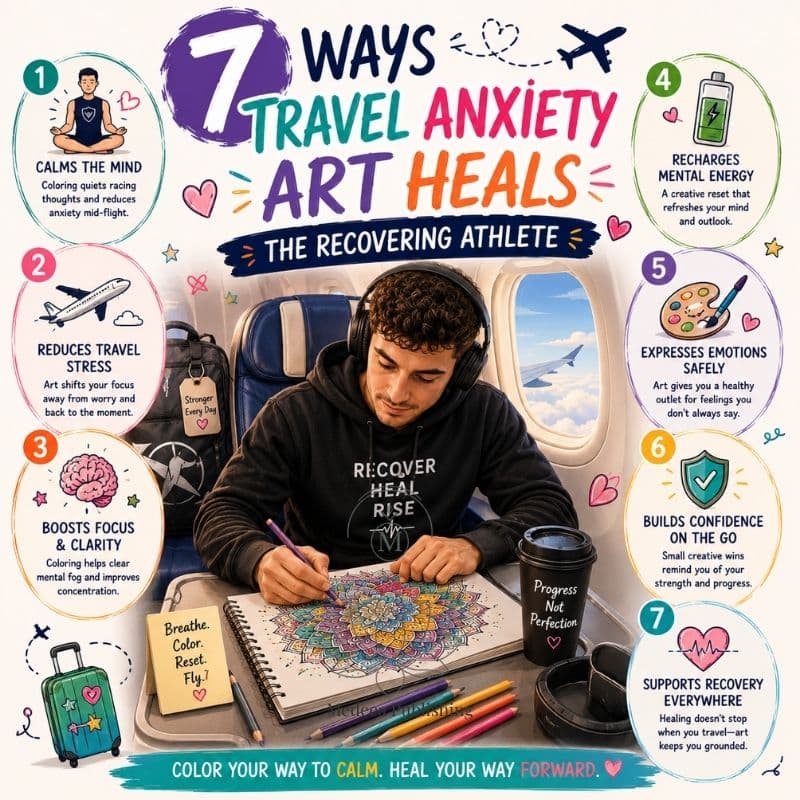
1. Replacing Physical Restlessness with Micro-Movements
The “itch” to move is real. When you can’t pace the aisle, the fine motor skills required for coloring provide a physical outlet. The rhythmic motion of the hand across the page satisfies the brain’s need for movement without requiring the space of a gym. This form of travel anxiety art keeps the hands busy and the mind occupied, preventing the “fidget-loop” that often leads to full-blown anxiety attacks.
2. Focus as a Form of Meditation
Many athletes find traditional meditation difficult because it feels too “passive.” Coloring is “active meditation.” You are doing something. For a recovering athlete, having a tangible result (a colored page) provides a sense of accomplishment that mimics the satisfaction of finishing a workout. This is why travel anxiety art is so effective; it speaks the language of the athlete—action and result.
3. Lowering the Amygdala’s Alarm
The amygdala is the part of the brain responsible for the fear response. On a plane, turbulence or loud noises can send the amygdala into overdrive. Engaging in travel anxiety art requires the use of the prefrontal cortex—the logical, “executive” part of the brain. When the prefrontal cortex is active, it inhibits the amygdala. Essentially, you are using your coloring book to tell your brain’s alarm system to stand down.
4. Establishing a Portable “Safe Zone”
One of the hardest parts of travel is the loss of a “home base.” By carrying Medeea Publishing coloring books, you carry a familiar, safe environment with you. The moment you open the book on your tray table, you are creating a psychological boundary between yourself and the chaotic environment of the plane. This is a key component of mental clarity exercises: creating a space where the external world cannot intrude.
Harnessing Travel Anxiety Art for Emotional Regulation
Emotional regulation is a skill that every elite athlete must master. Whether it’s staying calm after a bad call or maintaining focus during a high-stakes play, control is everything. Travel anxiety art acts as a training ground for this skill. If you find yourself getting frustrated with the constraints of the seat or the delay of the flight, the act of choosing colors and staying within the lines forces a level of emotional discipline that is highly transferable back to the field or court.
Furthermore, the use of color therapy—choosing blues and greens for calm, or yellows and oranges for energy—allows athletes to “check in” with their internal state. If you find yourself reaching for dark, heavy colors, it might be a sign that your travel anxiety art is revealing underlying stress that needs to be addressed through further mental clarity exercises or rest.
5. Cognitive Reframing of the “Recovery Phase”
Being a “recovering athlete” often feels like a negative state. However, using travel anxiety art allows you to reframe this time as a “mental training phase.” You aren’t just “coloring to pass the time”; you are “training your focus and patience.” This shift in perspective is vital for maintaining a positive athletic identity during periods of physical limitation.
6. Reducing “Screen Fatigue” and Information Overload
Most travelers default to movies or scrolling through social media. For an athlete already dealing with the mental fog of recovery, the blue light and dopamine spikes of a phone can actually increase anxiety. Travel anxiety art provides a “digital detox.” It allows your eyes to rest on a physical medium, reducing headaches and eye strain, and contributing to overall mental clarity exercises that are often disrupted by technology.
7. Building a Visual Journal of Your Journey
Each page you finish in your Medeea Publishing book is a milestone. You can look back at the pages colored during your most difficult travel days and see how far you’ve come. This visual progress is incredibly rewarding for athletes who are used to tracking statistics and personal bests. Your travel anxiety art becomes a record of your resilience.
Implementing Mental Clarity Exercises on Your Next Flight
To get the most out of your travel anxiety art, you need a plan. Athletes don’t wing it, and neither should you. Here is a step-by-step “Game Plan” for using coloring and mental clarity exercises to dominate your next flight.
Step 1: The Pre-Flight Ritual
Before you even leave for the airport, select your tools. Choose a coloring book from the Medeea Publishing collections that resonates with your current mood. Do you need the structure of mandalas, or the flowing lines of nature scenes? Pack a high-quality set of colored pencils (pens can leak in pressurized cabins) and ensure they are sharpened and ready. This preparation is part of the mental clarity exercises—it signals to your brain that you have a plan for the stress ahead.
Step 2: The Takeoff Transition
The period between boarding and reaching cruising altitude is often the most anxious. Use this time for breathing-based mental clarity exercises. Once the “electronics” sign is off, or even before if you are using physical books, open your travel anxiety art. Don’t worry about finishing a page; just start. The first few strokes are about grounding yourself in the present moment.
Step 3: Managing Mid-Flight Turbulence
If the plane hits a bump, your instinct might be to grip the armrests. Instead, grip your pencil. Lean into the travel anxiety art. Focus on the sensory details: the texture of the paper, the sound of the lead, the vibrant hue appearing on the page. This is a classic “grounding technique” used in clinical settings to manage panic. According to the Mayo Clinic’s insights on art therapy, focusing on the creative process can significantly reduce the physiological symptoms of stress.
Why Medeea Publishing is the Athlete’s Choice for Travel Anxiety Art
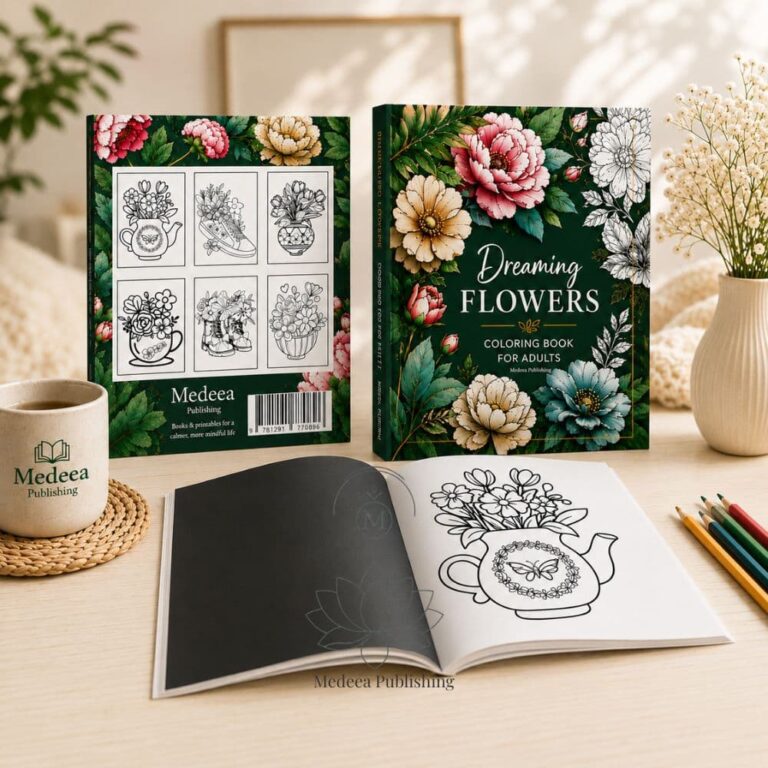
Not all coloring books are created equal. For a recovering athlete who values quality and intentionality, Medeea Publishing stands apart. Our books are designed with sophisticated patterns that provide the right level of challenge—enough to engage the mind without being so difficult that they cause further frustration.
The paper quality in a Medeea Publishing book ensures that your travel anxiety art looks professional and feels substantial. This tactile experience is a vital part of mental clarity exercises. When you use tools that feel “pro,” you approach the task with a professional mindset, which is exactly how an athlete handles any challenge.
The Psychological Bridge: From Coloring to Competition
The skills you build while practicing travel anxiety art at 30,000 feet are the same skills you will use when you return to your sport.
- Patience: Waiting for the right color is like waiting for the right opening in a game.
- Precision: Staying in the lines is like maintaining perfect form during a lift.
- Resilience: If you make a mistake with a color, you learn to adapt and incorporate it into the design—just as you must adapt to an opponent’s move.
By integrating travel anxiety art into your recovery, you are ensuring that your mind stays as sharp as your body was at its peak. This is the ultimate goal of mental clarity exercises: total integration of mind and body.
Advanced Mental Clarity Exercises to Pair with Art
To truly maximize the benefits of travel anxiety art, consider these advanced techniques during your flight:
Progressive Muscle Relaxation (PMR)
While you color, practice PMR. Tense and then release different muscle groups, starting from your toes and moving up to your jaw. This, combined with travel anxiety art, creates a total-body “reset.” It is particularly effective for recovering athletes who may be experiencing muscle stiffness from sitting in a cramped seat.
Visualization Techniques
As you fill in the patterns of your travel anxiety art, visualize your body healing. See the fibers of your muscles knitting back together or the inflammation in your joints subsiding. Athletes have used visualization for decades to improve performance; using it during coloring turns your book into a blueprint for your physical recovery.
Common Obstacles and How to Overcome Them
Even with the best intentions, travel anxiety art can sometimes feel daunting. You might worry about people looking at you, or you might feel that coloring is “childish.”
The “Judgment” Obstacle: Remember that your recovery is your priority. Most people on the plane are too busy with their own screens to notice yours. Furthermore, travel anxiety art is an increasingly common sight in airports. You are part of a growing movement of high-performers who prioritize mental health.
The “Perfectionism” Obstacle: As an athlete, you want to win. You want the page to be perfect. But the goal of travel anxiety art is the process, not the product. If a color doesn’t look right, let it go. This is a great way to practice letting go of mistakes during a game. Use your coloring book as a low-stakes environment to practice self-compassion.
Packing Your Travel Anxiety Art Kit: A Checklist
To ensure you are fully prepared for your mental clarity exercises, use this checklist before heading to the airport:
- A Medeea Publishing Coloring Book (Small sizes are great for tray tables).
- A set of 12-24 high-quality colored pencils.
- A small, enclosed pencil sharpener (to avoid mess).
- An eraser (for those moments when the perfectionist in you takes over).
- Noise-canceling headphones to pair your travel anxiety art with calming ambient music or binaural beats.
The Long-Term Benefits of Travel Anxiety Art for Athletes
The beauty of travel anxiety art is that its benefits extend far beyond the duration of your flight. For the recovering athlete, these mental clarity exercises build a foundation of mindfulness that will serve you for the rest of your career. When you eventually return to the field, you will have a more disciplined mind, a better ability to handle stress, and a proven method for finding “the zone” on demand.
Furthermore, the habit of creative expression provides a healthy outlet for the emotions that often accompany injury—frustration, sadness, or fear of the future. By channeling these into travel anxiety art, you prevent them from manifesting as physical tension or burnout.
Conclusion: Take Flight with Confidence
Recovery is not a passive process. It is an active, daily commitment to your physical and mental well-being. For the athlete facing the unique challenges of travel, travel anxiety art offers a powerful, portable, and scientifically-backed way to stay grounded. By choosing to engage in mental clarity exercises like coloring, you are taking control of your environment and your internal state.
Next time you find yourself at the gate, feeling the familiar hum of anxiety in your chest, reach into your bag. Pull out your Medeea Publishing Cozy Spaces coloring book. Remember that you are an athlete, and this is just another form of training. With every stroke of color, you are quieting the noise, sharpening your focus, and turning a stressful flight into a masterful session of travel anxiety art. Your body may be confined to a seat, but your mind is free to heal, create, and soar.
Embrace the journey. Trust the process. And let the art lead the way to your fastest recovery yet.
Frequently Asked Questions
Does travel anxiety art really work for everyone?
While everyone is different, the neurological principles behind coloring—focus, repetitive motion, and color stimulation—are universal. For athletes specifically, the transition to “active meditation” through coloring often feels more natural than silent sitting.
How long should I color during a flight?
There is no set rule, but even 15-20 minutes of travel anxiety art can significantly lower your heart rate and settle your nervous system. Use it as needed throughout the flight, especially during transitions like takeoff, landing, or service times.
What are the best patterns for mental clarity exercises?
Mandalas and repetitive geometric shapes are often best for mental clarity exercises because they require a balance of symmetry and creativity, which engages both hemispheres of the brain. You can find many of these designs in the Medeea Publishing blog updates and collections.