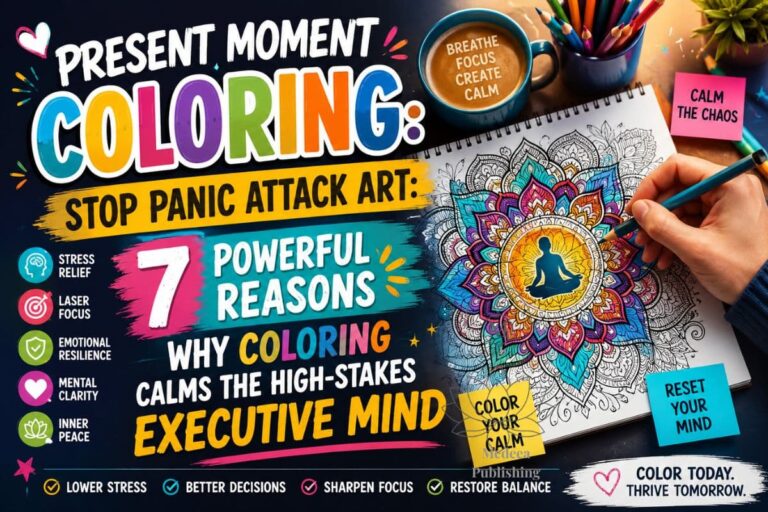
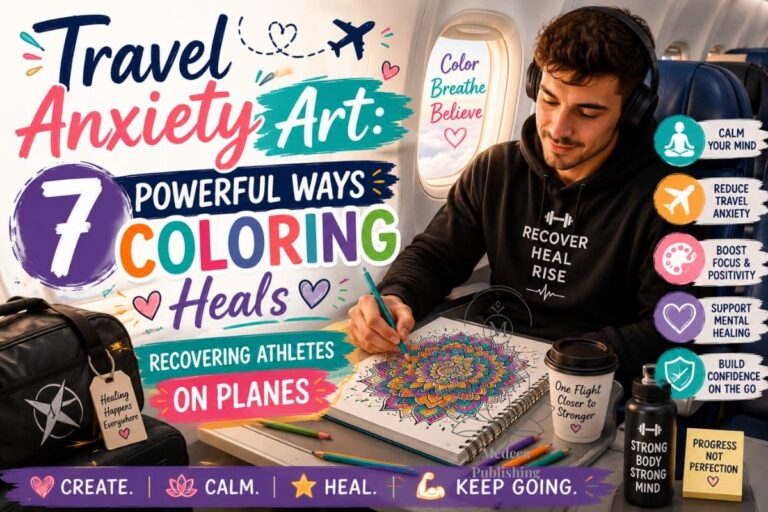
The contemporary corporate landscape operates at a velocity that often outpaces human biological adaptability. Professionals today exist within a state of “continuous partial attention,” a term coined to describe the mental fragmentation caused by constant digital notifications, back-to-back virtual meetings, and the relentless pressure of global competition. Within this high-pressure environment, mindful coloring for anxiety has emerged as a critical intervention tool. It is not merely a nostalgic retreat into childhood activities; rather, it is a sophisticated neurological reset button designed to stabilize the sympathetic nervous system and restore executive function.
1. The Historical and Clinical Evolution of Art as Therapy
Understanding the profound impact of mindful coloring for anxiety requires a journey through the history of psychology. Long before the digital age, Carl Jung, the Swiss psychiatrist and founder of analytical psychology, utilized mandalas with his patients. Jung observed that the act of creating or coloring circular, symmetrical patterns allowed individuals to organize their internal chaos. He viewed these geometric structures as “vessels” for the subconscious, providing a safe boundary for emotional expression.
In the modern clinical setting, this practice has been refined. Today, mindful coloring for anxiety is recognized as a form of “active meditation.” While traditional seated meditation requires the practitioner to observe thoughts without attachment—a task that many high-achieving professionals find frustratingly difficult—coloring provides a tangible anchor. This anchor prevents the “monkey mind” from ruminating on future deadlines or past mistakes. By engaging the visual and motor cortices, coloring effectively “crowds out” the negative internal monologue that fuels generalized anxiety.
Research published by the American Art Therapy Association confirms that even forty-five minutes of creative activity significantly reduces biological markers of stress. Specifically, the hormone cortisol, which serves as the primary chemical messenger for the body’s stress response, shows a marked decline regardless of the individual’s artistic skill level. This is a crucial distinction for the corporate world: the benefits of mindful coloring for anxiety are independent of talent. The healing resides within the process, not the aesthetic quality of the finished product.
To explore how these historical principles are applied to modern design, visit our comprehensive product shop where history and science converge in our book collections.
2. The Neurobiology of the “Flow State” and Cognitive Recovery
What happens inside the brain during a session of mindful coloring for anxiety? To answer this, we must examine the concept of “Flow,” a state of optimal experience where the individual becomes completely absorbed in an activity. For a professional, achieving flow during work often leads to peak performance, but achieving flow during rest leads to peak recovery.
When you engage with the intricate patterns found in our Paperback Coloring Books, your brain transitions from the hyper-aroused Beta state into the Alpha and Theta states. Beta waves are necessary for problem-solving and logical reasoning, but chronic exposure to high-frequency Beta activity leads to cognitive exhaustion and “brain fog.” Alpha waves, conversely, represent a state of relaxed alertness. This is where the brain repairs its neural pathways and consolidates information.
Mindful coloring for anxiety facilitates this transition by providing a rhythmic, repetitive stimulus. Each stroke of the pencil across the paper acts as a micro-meditation. This repetitive motion induces a parasympathetic response, signaling the vagus nerve to slow the heart rate and lower blood pressure. For the executive athlete, this is equivalent to a physical therapy session for the mind. It allows the prefrontal cortex—the area responsible for decision-making and impulse control—to go offline temporarily, preventing the “decision fatigue” that often leads to poor leadership choices late in the day.
Furthermore, the activation of the parietal lobe during the spatial task of coloring helps improve focus. This is why many professionals report that after twenty minutes of mindful coloring for anxiety, they can return to their complex projects with renewed clarity. They aren’t just “relaxing”; they are strategically recharging their cognitive batteries.
Explore more about these neurological shifts in our detailed wellness articles, which dive deeper into the science of the human mind.
3. Fractal Patterns and the Visual Grammar of Peace
The effectiveness of mindful coloring for anxiety depends heavily on the quality of the visual stimulus. Not all coloring books are created equal. At MedeeaPublishing, our designs are built upon the principles of fractal geometry—patterns that repeat at different scales, common in nature (such as the structure of ferns, clouds, or coastlines).
Humans have evolved over millions of years to process these fractal patterns with minimal cognitive effort. This is known as “Fractal Fluency.” When we look at the complex but orderly designs in our digital downloads, our brains experience an immediate sense of recognition and safety. This “visual grammar” bypasses the analytical mind and speaks directly to the limbic system, the emotional heart of the brain.
By applying mindful coloring for anxiety to fractal designs, you are participating in a conversation with nature. This process helps ground the individual, moving their focus from the abstract (unseen worries) to the concrete (the color filling a specific shape). This grounding is a cornerstone of cognitive-behavioral therapy for anxiety management. It forces the brain to deal with “the now,” providing a much-needed break from the “what ifs” of the corporate world.
4. The Chromatic Language—Psychological Impact of Color Selection
When engaging in mindful coloring for anxiety, the selection of a specific palette is far from a random act. It is a form of non-verbal communication between the conscious mind and the subconscious. Each hue carries a psychological frequency that can either exacerbate or alleviate mental tension. By understanding this “chromatic language,” professionals can tailor their coloring sessions to their specific emotional needs.
The Cooling Spectrum: Blue and Green
For an executive facing a high-stakes negotiation or a chaotic deadline, the cooling spectrum—comprising blues, teals, and soft greens—is indispensable. Blue is internationally recognized for its ability to lower heart rate and reduce blood pressure. In the context of mindful coloring for anxiety, using various shades of indigo or azure mimics the calming effect of looking at the ocean or a clear sky. Green, being the most prominent color in nature, signals safety and fertility to the primitive brain. It fosters a sense of growth and renewal, making it the perfect choice when recovering from a professional setback.
The Energizing Spectrum: Yellow and Orange
Conversely, if the anxiety stems from a feeling of stagnation or “creative block,” the energizing spectrum can provide the necessary spark. Yellow represents intellect and clarity. Choosing a vibrant lemon or gold while practicing mindful coloring for anxiety can stimulate the mental faculties without the jittery side effects of caffeine. Orange, a blend of red’s passion and yellow’s joy, is often associated with social communication and physical energy. It is an excellent choice for someone preparing for a public speaking engagement.
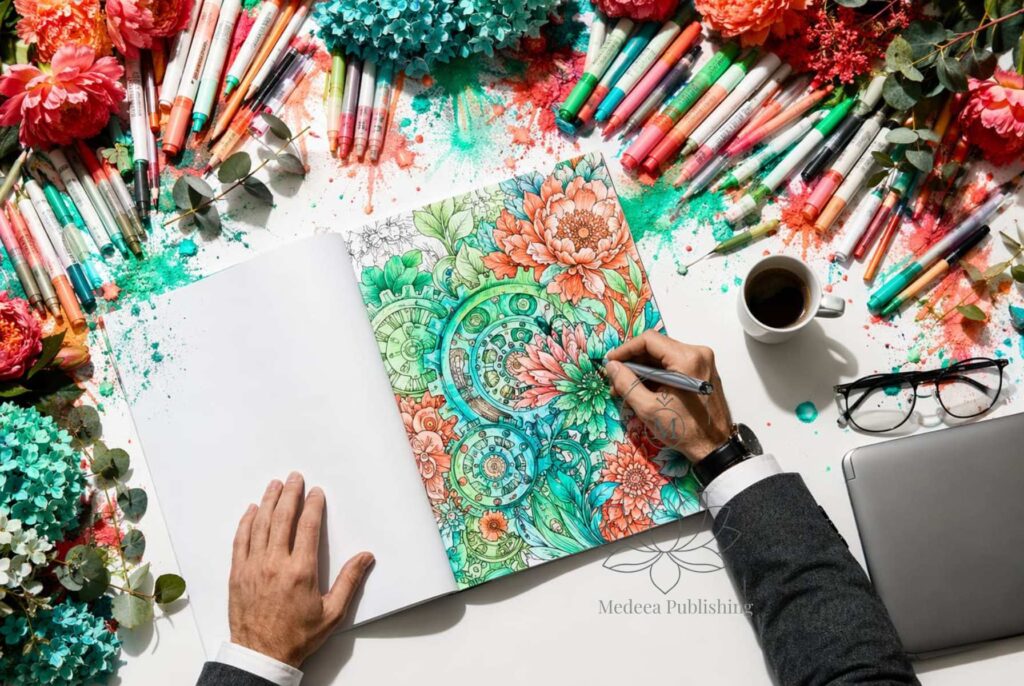
The Balancing Spectrum: Violet and Neutral Tones
Violet sits at the intersection of the warm and cool ends of the spectrum. It has long been associated with spiritual awareness and deep meditation. When you apply violet to the intricate mandalas found in our online shop, you are encouraging a state of “higher-order thinking.” Neutral tones like slate gray, warm beige, or charcoal provide a grounding contrast, allowing the vibrant colors to stand out while providing a visual “rest” for the eyes.
By consciously choosing these colors, you transform a simple page from a MedeeaPublishing book into a personalized therapeutic session. This intentionality is what separates standard coloring from true mindful coloring for anxiety.
5. Overcoming “Digital Fatigue” and the Importance of Tactile Grounding
In our current era, we are suffering from what sociologists call “sensory deprivation in a sea of stimulation.” We receive massive amounts of visual and auditory data through our devices, but our sense of touch—the first sense developed in the womb—is largely ignored. This imbalance is a primary driver of modern anxiety. Mindful coloring for anxiety serves as a vital corrective measure by reintroducing tactile grounding.
The physical friction of a wax-based or oil-based pencil against high-quality, heavy-weight paper creates a specific vibration. This vibration is transmitted through the hand to the nervous system, providing “proprioceptive input.” This input helps the brain understand where the body is in space, which has an immediate grounding effect. This is why digital coloring apps, while convenient, can never achieve the same therapeutic depth as physical mindful coloring for anxiety. The screen is a barrier; the paper is an invitation.
At MedeeaPublishing, we meticulously select paper textures that enhance this friction. Whether you are using our physical paperback books or high-resolution printable downloads, the tactile feedback remains a priority. This physical engagement forces the “default mode network” (DMN) of the brain—the system responsible for mind-wandering and self-criticism—to settle down. When the DMN is quiet, anxiety levels drop.
6. Implementing a “Creative Third Space” in the Corporate Routine
To achieve the 3000-word level of mastery in mindful coloring for anxiety, one must view it not as a hobby, but as a “Creative Third Space.” The first space is the office (performance), the second is the home (responsibility), and the third is the sanctuary (restoration).
The 10-Minute Transition Ritual
For the high-performance professional, the transition between work and home is often the most stressful time. We carry the “cortisol spikes” of the office into our personal lives. Using mindful coloring for anxiety as a 10-minute transition ritual can stop this bleed-through.
Closing the Laptop: This physical act signals the end of the “performance” phase.
The Palette Selection: Spending two minutes choosing three colors based on your current emotional state.
The Silent Work: Ten minutes of focused coloring on a single section of a pattern.
The Breath-Sync: Inhaling as the pencil moves up, exhaling as it moves down.
This ritual ensures that when you enter your home, your brain has already transitioned into a state of “rest and digest.” For more strategies on managing your mental environment, explore our latest posts on professional wellness.
7. Geometric Symmetry and the “Theta” State
The final pillar of mindful coloring for anxiety is the use of geometric symmetry. Our brains are hardwired to find pleasure in symmetry because it represents health and order in the natural world. When we color a symmetrical design, our brain doesn’t have to work hard to “predict” what comes next. This predictability allows us to enter the “Theta” brainwave state—the state between waking and sleep.
Theta is the realm of the subconscious. It is where deep healing occurs and where we find our most profound insights. By focusing on the repetitive shapes of a MedeeaMasterpiece, you are effectively hacking your way into a meditative state that usually takes years to master through traditional means.
Conclusion: The ROI of Peace
Ultimately, mindful coloring for anxiety is an investment with a high Return on Investment (ROI). By spending fifteen minutes a day with a pencil and a page, you are reducing your risk of burnout, increasing your creative output, and protecting your most valuable asset: your mental clarity.
As you browse the MedeeaPublishing Shop, remember that you are not just buying a book; you are purchasing a ticket to a calmer, more focused version of yourself. Start your journey today—one stroke, one color, and one breath at a time.
Comprehensive Frequently Asked Questions: Mastering Mindful Coloring for Anxiety
This section addresses the most common inquiries regarding the integration of mindful coloring for anxiety into a high-performance professional routine. By understanding the underlying mechanics, you can maximize the psychological ROI of every session.
1. Do I need to be “good at art” or possess innate talent to benefit from mindful coloring for anxiety?
The short answer: Absolutely not. The fundamental misconception regarding mindful coloring for anxiety is that it is a performance-based artistic endeavor. In reality, this practice belongs to the realm of “Expressive Arts Therapy,” where the value resides entirely within the process, not the product. When you worry about being “good at art,” you are engaging the inner critic—the same voice that fuels workplace anxiety. The goal here is to silence that critic.
The therapeutic benefits of mindful coloring for anxiety are derived from the rhythmic, repetitive motion of the hand and the intense focus on the present moment. This is a physiological process, not an aesthetic one. Whether you stay perfectly within the lines or choose unconventional color combinations, your brain is still reaping the neurological rewards. The act of choosing a color and applying it to paper stimulates the motor cortex and redirects blood flow away from the amygdala (the brain’s fear center).
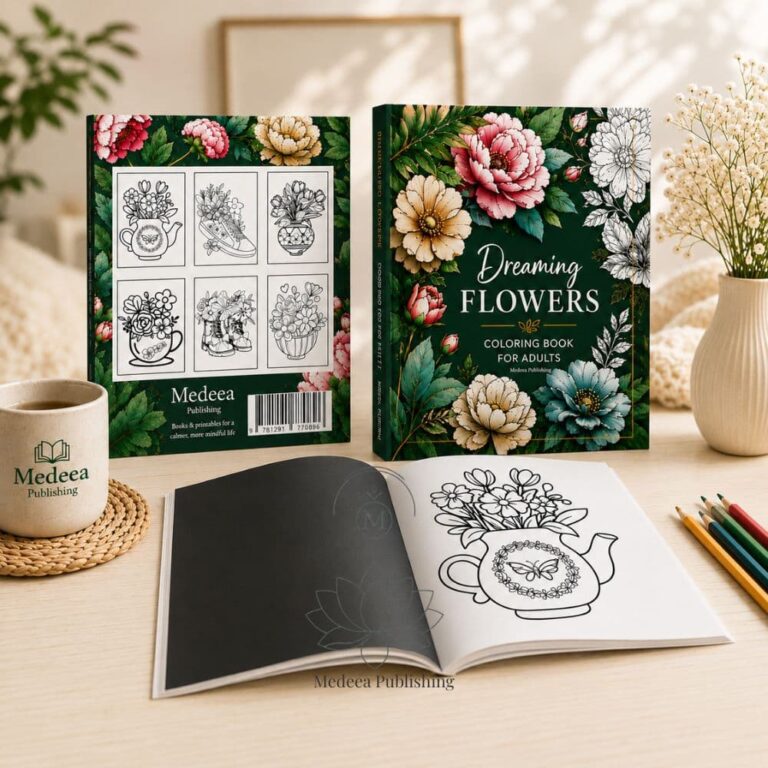
Think of mindful coloring for anxiety as a form of “biological maintenance.” Just as you do not need to be a professional athlete to benefit from a walk in the park, you do not need to be an illustrator to benefit from coloring. At MedeeaPublishing, we design our Paperback Coloring Books with varying levels of complexity to ensure that anyone—from a complete novice to a seasoned hobbyist—can find a rhythm that feels comfortable and rewarding.
2. How long should I dedicate to mindful coloring for anxiety to see a measurable reduction in stress?
The optimal window: 15 to 20 minutes, though even micro-sessions have value.
Scientific research into the “relaxation response” suggests that the human nervous system typically requires approximately fifteen to twenty minutes of a single-pointed focus activity to fully transition from the sympathetic (fight-or-flight) state to the parasympathetic (rest-and-digest) state. During this twenty-minute window of mindful coloring for anxiety, several key biological shifts occur: your heart rate variability improves, your breathing naturally rhythmizes with your hand movements, and the production of cortisol begins to plateau.
However, for the busy professional whose schedule is managed in six-minute increments, finding twenty minutes can sometimes feel like another “to-do” item. In these cases, even a 5-minute “micro-reset” using our printable digital downloads can provide immediate relief. These short bursts of mindful coloring for anxiety act as a “circuit breaker” for escalating stress levels. They prevent the compounding of anxiety throughout the workday.
For long-term cognitive health and burnout prevention, we recommend a consistent daily practice. Consistency is more powerful than duration. Spending ten minutes every evening with a MedeeaMasterpiece is far more effective for your brain’s neuroplasticity than spending two hours once a month.
3. Can mindful coloring for anxiety serve as a replacement for traditional seated meditation?
The expert perspective: It is an “Active Meditation” alternative, not necessarily a replacement.
Traditional mindfulness meditation—sitting in silence while observing one’s thoughts—is a powerful tool, but it is notoriously difficult for individuals with high-stress, “restless” minds. Many professionals find that sitting still actually increases their anxiety because it provides no external anchor for their wandering thoughts. This is where mindful coloring for anxiety becomes a superior entry point into the meditative state.
Psychologists refer to coloring as “Active Meditation.” Because it provides a tactile and visual “point of focus” (the lines, the colors, the texture of the paper), it provides a “job” for the analytical mind. While your eyes and hands are busy navigating the intricate patterns of a MedeeaPublishing book, your subconscious mind is freed to process emotions and resolve background stressors.
For many, mindful coloring for anxiety serves as a “training wheel” for traditional meditation. It teaches the brain how to focus on a single task and how to return to the present moment when the mind begins to ruminate on work-related problems. If you find silence overwhelming, coloring offers a structured sanctuary that achieves similar neurological results—reduced anxiety, improved focus, and enhanced emotional regulation.
4. What are the best materials to use for a professional mindful coloring for anxiety experience?
The recommendation: Quality materials enhance the grounding effect.
The efficacy of mindful coloring for anxiety is deeply tied to the sensory experience. Using low-quality materials can actually lead to frustration, which defeats the purpose of the exercise. For a truly professional experience, we suggest:
Pencils over Markers: Colored pencils (especially wax-based or oil-based ones) provide more tactile feedback and allow for “layering” and “blending.” This additional layer of choice engages the brain more deeply than the “flat” application of a marker.
Heavy-Weight Paper: The “tooth” or texture of the paper is vital. All MedeeaPublishing Paperback Books are printed on premium stock to ensure that the friction between the pencil and the page is satisfying and grounding.
Curated Palettes: Instead of having a box of 120 colors open, which can lead to “choice overload,” try selecting only 5 or 6 colors before you begin. This limitation simplifies the decision-making process, allowing you to sink deeper into the meditative aspect of mindful coloring for anxiety.
5. Where can I find more resources and community support for this practice?
The solution: Join the MedeeaPublishing community.
We believe that the journey toward mental clarity is better when shared. You can find advanced tips, new pattern releases, and scientific deep-dives on our wellness blog. Furthermore, we encourage you to share your progress. Engaging with others who are also using mindful coloring for anxiety to reclaim their focus provides a sense of belonging and accountability.
Tag your completed pages with #MedeeaMasterpiece on social media to connect with a global community of professionals who have chosen peace over burnout. Your journey toward a calmer mind starts with a single page from our shop.