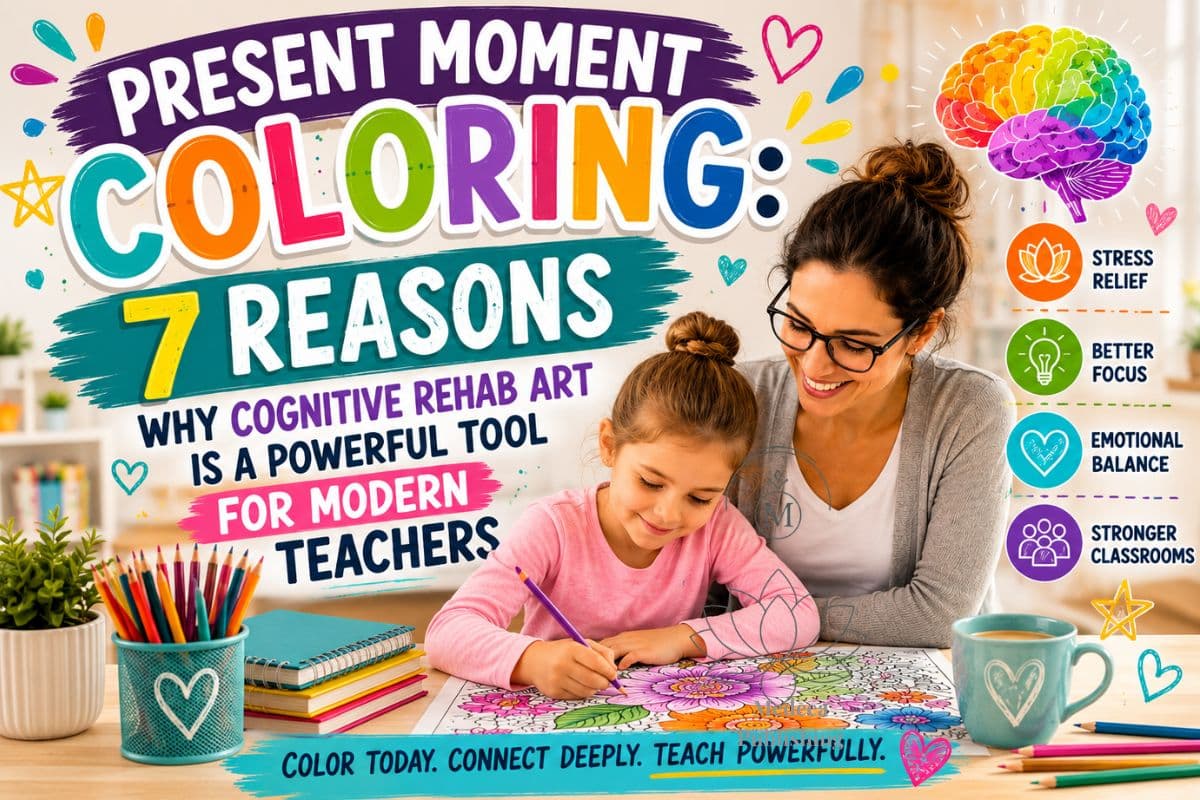

In the modern classroom, teachers are no longer dealing only with curriculum delivery. They are working inside environments defined by cognitive overload, emotional instability, and declining attention spans. Students arrive already overstimulated, often mentally fatigued before the lesson even begins. This shift has forced educators to rethink how learning actually happens. It is no longer enough to present information. The brain must first be stabilized before it can process anything effectively. This is where Cognitive Rehab Art becomes a practical and necessary tool.
Coloring Art is not about creativity in the traditional sense. It is a structured method that uses controlled visual activity to restore balance in the brain. When students engage with structured patterns, especially through coloring books for beginners, they activate multiple systems at once: visual tracking, motor control, and decision-making. This combination creates a stabilizing effect that reduces internal noise and improves clarity. Unlike passive relaxation, this method engages the brain without overwhelming it, making it particularly effective in overstimulated environments.
One of the reasons Creative Art works so well is because it removes resistance. Many students struggle not with completing tasks, but with starting them. Traditional academic work often triggers avoidance because it feels complex or demanding. In contrast, relaxing coloring offers a simple entry point. The student does not need to plan or solve a problem—they only need to begin. This small shift lowers cognitive load and allows engagement to happen naturally. Over time, this builds a habit of starting tasks without hesitation.
The neurological impact of this method is supported by research. According to the Mayo Clinic, repetitive creative activities can significantly reduce stress levels and improve mental clarity. This explains why calming coloring has become a widely used tool in both educational and therapeutic settings. By engaging in repetitive motion, the brain shifts from a reactive state into a regulated one. This transition is critical for learning, as a stressed brain cannot process information efficiently.
Another important aspect of Coloring Art is predictability. Students respond better to structured environments where expectations are clear. Coloring books for beginners provide this structure through defined boundaries and repeatable patterns. This predictability reduces anxiety and increases participation. Instead of facing an open-ended task, the student works within a controlled framework. This creates a sense of safety, which is essential for cognitive engagement.
Emotional regulation is another area where this method proves highly effective. Many students experience stress but lack the tools to process it. This often leads to behavioral issues or disengagement. Stress relief coloring provides a non-verbal way to release tension. The act of filling shapes with color allows students to process emotions without needing to articulate them. Over time, this builds emotional awareness and reduces reactive behavior. Teachers who incorporate relaxing coloring into their routines often report calmer classrooms and smoother transitions between activities.
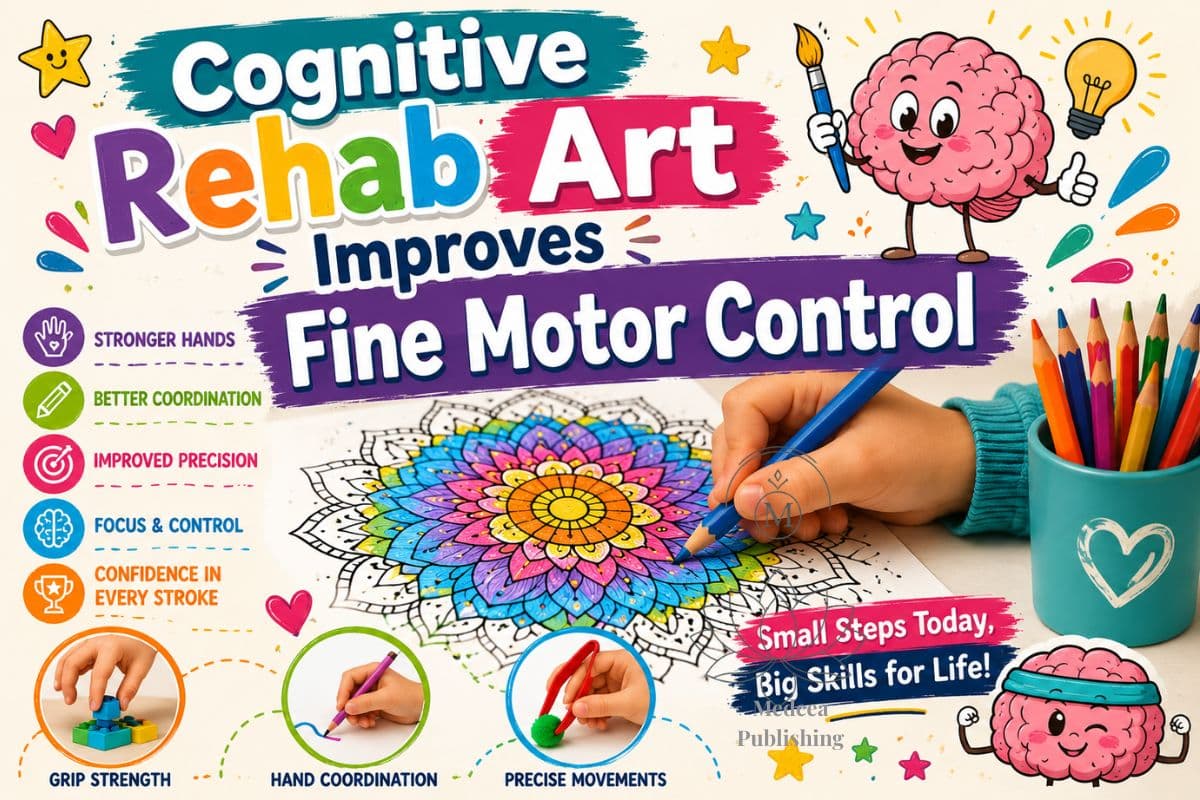
1. Cognitive Rehab Art Improves Fine Motor Control
The Decline of Precision Skills
In recent years, one of the most noticeable changes in student development has been the decline of fine motor precision. This is not a question of intelligence or ability, but of exposure and repetition. Students today interact far more with screens than with physical tools. Swiping, tapping, and scrolling have replaced writing, drawing, cutting, and other activities that require controlled hand movement. As a result, many students struggle with tasks that depend on coordination, such as handwriting, drawing straight lines, or maintaining consistent pressure with a pen or pencil.
This decline has direct consequences in the classroom. When students lack fine motor control, simple academic tasks become more demanding. Writing takes longer, becomes frustrating, and often leads to avoidance. The student’s attention shifts away from the content and toward the effort required to execute the task. Over time, this creates a negative association with learning activities that involve manual precision. What appears as lack of motivation is often a response to difficulty at a fundamental level.
How This Method Rebuilds Control
Creative Art addresses this issue by reintroducing controlled, repeatable movement in a low-pressure environment. Through coloring books for beginners, students engage in guided hand movement that gradually rebuilds coordination. The act of following lines, adjusting pressure, and filling shapes requires constant communication between the brain and the hand. Each movement reinforces neural pathways responsible for precision and control.
Unlike traditional exercises that may feel repetitive or demanding, coloring provides immediate visual feedback. Students can see their progress in real time, which increases engagement and reduces frustration. This feedback loop is essential. It encourages continuation without the need for external validation. The student is not working toward a grade or evaluation, but toward completion of a visible, manageable task.
Over time, these repeated movements improve grip strength, stability, and directional accuracy. Students begin to apply this improved control in other areas, such as writing and drawing. Teachers often observe that students who regularly engage in show smoother handwriting, better spacing, and increased confidence when working with physical tools. This improvement is not accidental—it is the result of consistent, structured practice embedded in a simple activity.
2. Stress Relief Coloring Reduces Emotional Overload
Emotional Pressure in the Classroom
Modern classrooms are environments of constant stimulation. Students are exposed to academic expectations, social dynamics, and external influences that increase stress levels throughout the day. For many, this leads to a state of continuous tension. When the brain remains in this heightened state, it becomes difficult to focus, process information, or respond calmly to challenges.
Emotional overload does not always appear as visible distress. It often manifests as distraction, irritability, or disengagement. Students may struggle to follow instructions, complete tasks, or interact positively with others. Without tools for regulation, this state persists and interferes with learning. Teachers are then placed in the position of managing both academic instruction and emotional stabilization simultaneously.
The Regulation Effect
Stress relief coloring provides a structured method for reducing this overload. The repetitive motion involved in coloring slows the nervous system and creates a predictable rhythm. As the student focuses on filling shapes and following patterns, breathing becomes more regular, muscle tension decreases, and mental activity begins to stabilize. This process shifts the brain from a reactive state into a regulated one.
Research supports this effect. According to Psychology Today, structured creative activities can significantly reduce anxiety and improve emotional regulation. This is why Calming coloring is increasingly used as a practical tool in both educational and therapeutic settings.
Teachers often introduce this method using structured resources such as Medeea Publishing. These materials are designed to provide the right balance between simplicity and engagement, allowing students to enter the activity without resistance. Over time, regular use of relaxing coloring creates a more stable classroom environment where students are better equipped to manage their emotions and remain engaged.
3. Relaxing Coloring Builds Sustained Attention
The Attention Problem
Attention has become one of the most fragile cognitive functions in modern students. Constant exposure to fast-paced digital content has conditioned the brain to expect rapid changes and immediate rewards. As a result, tasks that require sustained focus feel slow and difficult. Students may begin an activity but quickly lose interest, shifting their attention to something more stimulating.
This pattern creates a cycle where focus becomes increasingly difficult to maintain. The brain becomes accustomed to interruption, and the ability to stay engaged with a single task weakens over time. In a classroom setting, this leads to incomplete work, frequent distractions, and reduced comprehension.
Training the Focus System
Relaxing coloring provides a direct method for rebuilding attention. Unlike activities that rely on external stimulation, coloring requires the student to generate focus internally. The task is simple, but it demands consistency. The student must follow patterns, maintain alignment, and complete sections step by step. This continuous engagement trains the brain to sustain attention without relying on constant novelty.
Each completed section reinforces the ability to remain focused. The brain begins to adapt to this slower, more controlled pace. Over time, students develop greater attention endurance, allowing them to engage with more complex tasks without becoming overwhelmed. This is one of the core benefits of Cognitive Rehab Art—it strengthens the focus system through repetition and structure.
Educators often support this progression by introducing more detailed designs from Medeea Publishing Coloring Books: Cozy Spaces Coloring Book, Cozy Cafe Coloring Book, Reading Nook Coloring Book. As students become more comfortable with basic patterns, they transition to more complex ones, gradually increasing the duration and intensity of their focus. This step-by-step approach ensures that attention is built sustainably, without creating frustration or resistance.
Ultimately, relaxing coloring transforms attention from a fragile resource into a trainable skill. By engaging in consistent, structured practice, students learn not only how to focus, but how to maintain that focus over time.
4. Coloring Art Supports Neurodiverse Students
The Need for Structured Stimulation
Students with ADHD, autism, or sensory processing differences often struggle not because they lack ability, but because the learning environment is misaligned with how their brain functions. Traditional classroom expectations—such as sitting still, maintaining silent focus, and processing information passively—can create internal conflict. For many neurodiverse learners, stillness does not equal focus. In fact, it often increases restlessness, distraction, and cognitive fatigue.
These students frequently require a specific type of input: structured stimulation. Without it, the brain begins to search for engagement elsewhere, leading to fidgeting, distraction, or disengagement. This is not a behavioral issue—it is a neurological response to under- or over-stimulation. When the environment does not provide the right level of input, the brain compensates in ways that are often misunderstood in traditional educational settings.
This is why many conventional strategies fail. Asking a student with ADHD to “just focus” or “sit still” ignores the underlying need for controlled engagement. Without a structured outlet, attention becomes unstable and difficult to direct. Over time, this creates frustration for both the student and the teacher.
Why Coloring Art Creates Balance
Coloring Art directly addresses this imbalance by providing controlled, predictable stimulation. Through relaxing coloring, the student is allowed to move, engage visually, and maintain focus at the same time. This combination is critical. Instead of forcing the brain into stillness, the method works with its natural need for activity.
The repetitive motion used in stress relief coloring acts as a stabilizing mechanism. It gives the brain something consistent to follow, reducing the need to seek stimulation elsewhere. At the same time, the visual structure of the design provides clear boundaries, which helps organize attention. This dual effect—movement plus structure—is what makes the method effective for neurodiverse learners.
Students who engage in Cognitive Rehab Art often show improved ability to remain present during lessons. This is not because they are trying harder, but because their brain is no longer overloaded or under-stimulated. The activity creates a balanced state where attention can be maintained without strain.
Supporting Focus Without Suppressing Movement
One of the key advantages of this approach is that it does not suppress natural behavior—it redirects it. Many neurodiverse students need movement to think clearly. Instead of eliminating that movement, relaxing coloring channels it into a structured form. The hand moves, the eyes follow, and the brain stays engaged.
This is particularly effective during listening-based activities. Teachers often observe that students who color while listening:
- interrupt less
- retain more information
- remain seated for longer periods
- show improved comprehension
This happens because the part of the brain that seeks stimulation is occupied, allowing the rest of the cognitive system to process incoming information more effectively.
Creating Predictable and Safe Learning Conditions
Predictability is essential for many neurodiverse learners. Unexpected changes, unclear instructions, or open-ended tasks can create anxiety and reduce participation. Coloring books for beginners provide a stable framework where expectations are clear. Each page follows a consistent structure, allowing the student to focus on execution rather than interpretation.
This sense of predictability reduces cognitive load and increases willingness to engage. Students know what to do, how to do it, and what to expect. This clarity is often missing in traditional tasks, where ambiguity can lead to hesitation or avoidance.
Teachers who integrate structured creative tools, such as those discussed on Medeea Publishing Shop, often find that students respond more positively to lessons when this type of activity is included as part of the routine.
5. Stress Relief Coloring Improves Memory Retention
Learning Through Multi-Sensory Engagement
Memory is not a single process—it is the result of multiple systems working together. When information is processed through only one channel, such as reading or listening, retention is limited. However, when visual, motor, and cognitive systems are engaged simultaneously, the brain creates stronger and more durable connections.
This is where stress relief coloring becomes particularly valuable. While it may appear simple, it activates several layers of processing at once. The student is seeing, moving, deciding, and repeating patterns in a controlled way. This multi-sensory engagement enhances the brain’s ability to store and retrieve information.
The Role of Visual Anchoring
One of the most effective mechanisms behind this process is visual anchoring. When students associate colors, shapes, and patterns with specific information, they create mental reference points. These reference points make recall easier because the brain can access multiple cues instead of relying on a single memory trace.
For example, when a student uses coloring while learning a concept, they are not just passively receiving information. They are actively linking that information to a visual and physical experience. This makes the memory more stable and easier to retrieve later.
Practical Classroom Application
Teachers can integrate this method directly into lessons. Instead of separating creative activity from academic work, they can combine them. Students can use structured designs while listening, reviewing, or processing information. Materials such as those available at Medeea Publishing Shop provide a consistent framework for this type of integration.
When students engage in Creative Art during learning, they remain in a state of optimal activation. They are neither bored nor overwhelmed. This balance is essential for memory formation. Information processed in this state is more likely to be retained and recalled accurately.
From Passive Learning to Active Encoding
Traditional learning often relies on passive intake, where students listen or read without active engagement. This approach is limited because it does not fully involve the brain. By incorporating stress relief coloring, learning becomes an active process. The student is not just receiving information—they are interacting with it.
Over time, this approach strengthens cognitive flexibility and improves the ability to connect ideas. Students become more capable of organizing information, recognizing patterns, and applying knowledge in different contexts.
Ultimately, the integration of Coloring Art transforms how information is processed. It moves learning from a passive experience into an active, multi-layered system where memory is reinforced through repetition, structure, and engagement.
6. Coloring Books for Beginners Build Confidence
The Fear of Failure
In many classrooms, one of the most underestimated barriers to learning is not difficulty—it is fear. Students often hesitate to begin tasks because they are afraid of making mistakes, being judged, or not meeting expectations. This fear is especially strong in environments where outcomes are evaluated, corrected, or compared. Over time, this creates a pattern of avoidance. Students delay starting, rush through tasks, or disengage completely, not because they lack ability, but because they associate effort with the risk of failure.
This psychological barrier affects participation, focus, and overall learning capacity. When a student approaches a task with anxiety, the brain shifts into a defensive state. In this state, attention narrows, creativity decreases, and cognitive flexibility is reduced. Instead of exploring or engaging, the student is trying to protect themselves from making a mistake. This is one of the core challenges modern teachers face daily.
Removing Pressure Through Structured Success
This is where coloring books become a powerful intervention. Unlike traditional academic tasks, they remove the concept of failure entirely. There is no “wrong answer,” no grading system, and no expectation of perfection. The only objective is participation. This creates a completely different psychological environment—one where the student can engage without fear.
When students begin working with structured designs, they quickly experience completion. Even small progress, such as filling a section with color, provides a sense of accomplishment. These micro-successes are critical. They rebuild trust in the learning process. Instead of associating tasks with pressure, the student begins to associate effort with achievable results.
Over time, this repeated experience of safe completion strengthens confidence. Students become more willing to start tasks, take small risks, and stay engaged for longer periods. This shift is subtle but powerful. Confidence does not come from being told “you can do it,” but from repeatedly experiencing success in a controlled environment.
The Role of Structure in Building Confidence
The structured nature of coloring books is essential to this process. Clear outlines, defined spaces, and guided patterns reduce decision fatigue. Students do not need to plan complex actions or worry about outcomes. They simply follow the structure. This reduces cognitive load and allows the brain to focus on execution rather than evaluation.
In this context, even students who typically struggle with attention or motivation find it easier to engage. The task feels manageable. The boundaries provide clarity. This combination creates a stable entry point into focus and participation, which can later transfer into more complex academic tasks.
From Low-Stakes Activity to Real Academic Impact
Although coloring may seem simple, its impact extends beyond the activity itself. When students build confidence through coloring books for beginners, they carry that confidence into other areas of learning. They become more willing to attempt writing tasks, participate in discussions, and engage with challenging material.
Teachers often observe that students who regularly engage in structured creative activities show:
- increased task initiation
- reduced avoidance behavior
- improved persistence
- more positive attitudes toward learning
This transformation happens because the student’s internal experience changes. Instead of expecting failure, they begin to expect progress.
Creating a Safe Zone for Growth
Providing access to tools like relaxing coloring books allows teachers to create a safe, structured environment where students can succeed without pressure. These resources are designed to support gradual engagement, offering a balance between simplicity and structure that encourages participation without overwhelming the student.
In this space, learning becomes less about performance and more about process. Students are not judged—they are supported. This shift is essential for building long-term confidence and creating a classroom environment where all learners feel capable of engaging.
Ultimately, coloring books are not just creative tools. They are confidence-building systems. By removing fear, reducing pressure, and providing consistent opportunities for success, they help students rebuild a positive relationship with learning—one small, controlled step at a time.
7. Coloring Art Reduces Teacher Burnout
The Emotional Load of Teaching
Teaching today extends far beyond delivering lessons. Educators are constantly managing attention shifts, emotional reactions, classroom behavior, and the invisible pressure students bring with them each day. This continuous need to regulate both the environment and the people within it creates a high level of cognitive and emotional strain. Over time, this leads to fatigue, reduced patience, and ultimately burnout. The challenge is not only the volume of work, but the intensity of constant responsiveness.
Co-Regulation Through Coloring
Coloring Art introduces a practical way to reduce this pressure. When teachers engage in relaxing coloring, even for short periods, they shift their nervous system from a reactive state into a controlled and stable one. This is not just personal relaxation—it directly influences the classroom. Students naturally mirror calm behavior, creating a shared regulation effect. This process, known as co-regulation, helps stabilize the entire learning environment. Through simple, structured anxiety relief coloring, teachers can lower overall tension, improve focus, and create a more balanced and sustainable teaching rhythm.
How to Implement Cognitive Rehab Art
Morning Reset
Starting the day with short anxiety relief coloring sessions allows students to transition from external distractions into a focused state. Instead of beginning the day with scattered attention, this structured activity creates immediate calm and prepares the brain for learning.
Transitions
Transitions between lessons are often chaotic and mentally draining. Introducing calming coloring during these moments helps maintain continuity. It prevents cognitive overload and allows students to reset before engaging with new material.
Emotional Break
Providing access to coloring books gives students a self-regulation tool they can use independently. When overwhelmed, they can step into a controlled activity that restores balance without disrupting the entire class.
Closure
Ending the day with structured Cognitive Rehab Art helps release accumulated stress. It allows students to leave the classroom in a calmer state, reinforcing emotional stability beyond school hours.
Frequently Asked Questions
1. How often should Creative Art be used in a classroom setting?
Creative Art delivers the strongest results when it is applied consistently rather than occasionally. Daily use, even in short intervals of 5 to 10 minutes, is significantly more effective than longer sessions used sporadically. The reason for this lies in how the brain builds stability. Repetition creates neural familiarity, and familiarity reduces resistance. When students regularly engage in relaxing coloring, their brain begins to recognize the activity as a safe and predictable space. This allows them to transition into focus more quickly each time.
Over time, these short sessions accumulate into measurable improvements. Students become faster at settling, more consistent in attention, and less reactive emotionally. Teachers also benefit from this consistency, as it creates a reliable tool that can be used during transitions, before demanding tasks, or after moments of disruption. In practice, Cognitive Rehab Art becomes part of the classroom rhythm, not an occasional intervention.
2. Is Cognitive Rehab Art suitable for all age groups?
Yes, Cognitive Rehab Art is adaptable across all age groups, but the level of complexity must match the developmental stage of the student. Younger students benefit most from simple, clearly defined patterns found in coloring books, where the focus is on basic coordination and task initiation. These designs provide immediate success, which is essential for building engagement and confidence.
Older students, on the other hand, require more complex patterns to maintain interest and challenge their focus. For them, stress relief coloring becomes less about simplicity and more about sustained attention and precision. The key is not the age of the student, but the level of cognitive demand that the design creates. When the challenge is balanced correctly, the method remains effective regardless of age.
3. Does Art improve academic performance?
Art does not directly teach academic content, but it significantly improves the conditions required for learning. Students who regularly engage in stress relief coloring demonstrate better focus, reduced anxiety, and increased task completion. These improvements directly influence academic performance because learning depends on attention and emotional stability.
When the brain is calm and regulated, it can process information more efficiently. Students are more likely to follow instructions, retain information, and complete assignments. In this way, Art acts as a foundational support system. It does not replace traditional teaching methods, but it enhances their effectiveness by preparing the brain to engage with them.
4. What materials work best for Coloring Art?
The effectiveness of Coloring Art depends partly on the quality and type of materials used. Colored pencils are generally the best choice because they offer precise control, consistent resistance, and clear visual feedback. These characteristics are essential for maintaining the structured engagement required in stress relief coloring.
Markers can be used, but they often reduce control and can increase stimulation, which may not be suitable for all students. The paper quality also plays a role. Smooth, durable pages, such as those found in well-designed simple coloring books , provide a better sensory experience and support consistent movement. The goal is to create an environment where the student can focus on the activity without being distracted by the tools themselves.
5. Can Cognitive Rehab Art help students with ADHD?
Yes, Cognitive Rehab Art is particularly effective for students with ADHD because it provides structured stimulation rather than demanding stillness. Many ADHD students struggle to focus because their brain is either under-stimulated or overstimulated. Relaxing Activities offers a balanced level of input that keeps the brain engaged without overwhelming it.
The repetitive motion and visual structure help regulate attention by giving the brain a clear point of focus. This reduces the need to seek stimulation through movement or distraction. As a result, students are more able to remain present during lessons. Over time, this improves their ability to manage attention in other contexts as well.
6. How quickly does Cognitive Rehab Art produce results?
The calming effects of Coloring activity Art can be observed almost immediately. Within a few minutes of starting stress relief coloring, many students show visible signs of relaxation, such as slower breathing, reduced movement, and increased focus. This immediate effect makes it a valuable tool for managing transitions or de-escalating situations in real time.
However, long-term benefits develop through consistent use. Improvements in attention, emotional regulation, and task persistence occur gradually as the brain adapts to the structured activity. This is why regular practice is essential. Coloring is not a one-time solution, but a process that builds stability over time.
7. Can teachers benefit from using Coloring themselves?
Yes, teachers benefit significantly from engaging in Coloring Art. Teaching requires constant emotional regulation, decision-making, and attention management, all of which contribute to mental fatigue. Participating in relaxing coloring allows teachers to reset their own cognitive and emotional state.
This is not only beneficial for the individual teacher, but also for the classroom as a whole. When a teacher is calm and focused, students tend to mirror that state. This creates a more stable and controlled learning environment. In this sense, supports co-regulation, where the emotional state of the teacher positively influences the students.
Conclusion
Cognitive Rehab Art is no longer a secondary or optional activity in modern education. It is a functional tool that addresses some of the most pressing challenges faced by both students and teachers. By combining structured engagement with emotional regulation, it creates the conditions necessary for effective learning. Through consistent use of stress relief coloring, relaxing activities, and coloring books for beginners, classrooms can become more focused, more stable, and more productive.
The strength of this method lies in its simplicity. It does not require complex systems or advanced training. It relies on repetition, structure, and accessibility. These elements make it sustainable over time and adaptable to different learning environments. As educational demands continue to evolve, tools like Coloring will play an increasingly important role in supporting cognitive clarity, emotional balance, and long-term learning success.