University life is often portrayed as a golden era of discovery and social growth, but for those living it, the reality is frequently more intense. Between looming deadlines, complex social dynamics, and the pressure of future career paths, students are facing unprecedented levels of stress and burnout. In the search for mental health tools, two terms often surface: art therapy vs coloring and recreational coloring. Understanding the nuance of art therapy vs coloring is essential for any student looking to safeguard their mental well-being while navigating academic rigor.
In this comprehensive guide, we will explore why these two activities, while seemingly similar, serve different purposes in a student’s mental health toolkit. We will also look at how integrating these practices into your evening relaxation routine can significantly improve your sleep quality and emotional regulation. Whether you are a psychology major curious about clinical applications or a STEM student just looking for a way to stop your brain from whirring at 2:00 AM, Medeea Publishing is here to help you find the right path to peace.
Understanding the Basics: Art Therapy vs Coloring
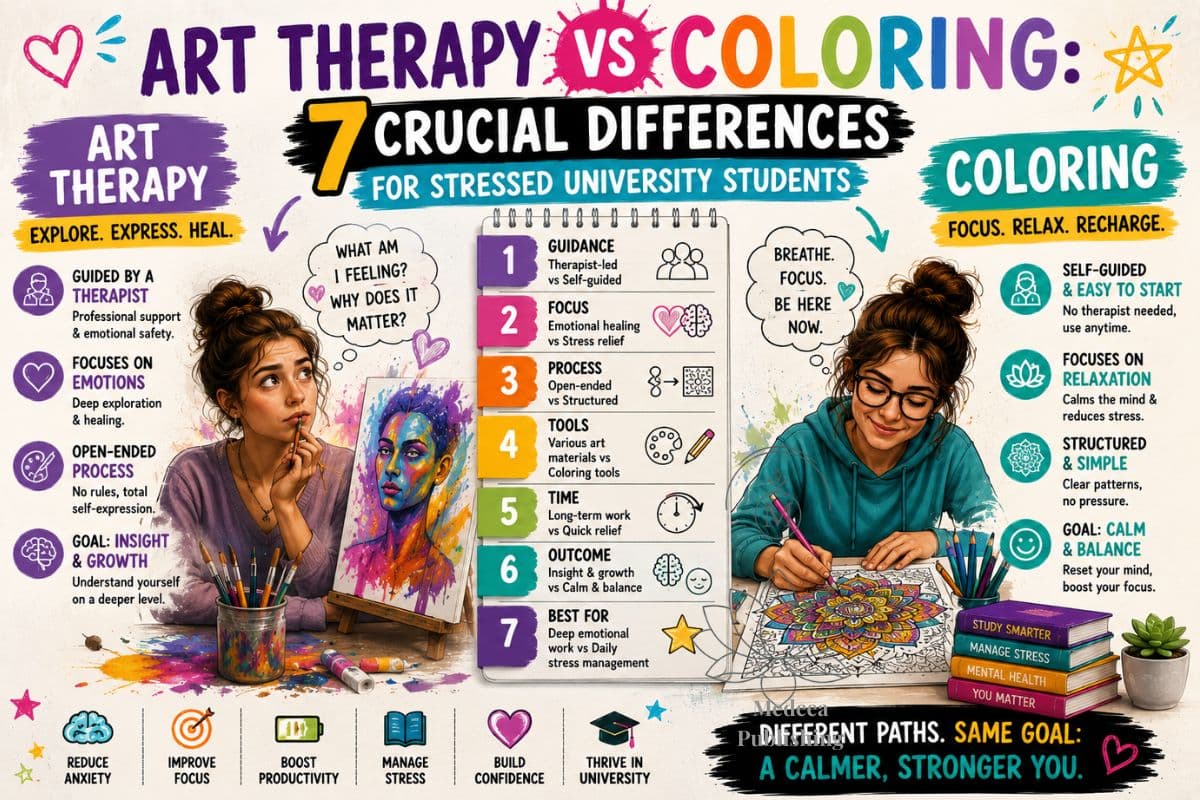
To begin our journey, we must define our terms. When we discuss art therapy vs coloring, we are comparing a clinical, evidence-based psychological intervention with a self-directed wellness activity. Both have immense value, but they are not interchangeable.
What is Art Therapy?
Art therapy vs coloring is a formal mental health profession. It requires a master’s degree and a credentialed professional—an art therapist. In a session, the therapist uses the creative process, psychological theory, and human experience to help clients navigate trauma, resolve conflicts, and improve their sense of well-being. According to Psychology Today, art therapy is particularly effective for those who find it difficult to express their feelings in words.
For a university student, art therapy vs coloring might involve exploring the “why” behind their anxiety. The therapist might ask the student to draw their “academic pressure” and then work through the symbols and colors used to uncover deeper cognitive patterns. It is a process of deep exploration guided by an expert.
What is Recreational Coloring?
Recreational coloring, on the other hand, is a self-care activity. It involves filling in pre-drawn designs—like those found in Medeea Publishing’s exquisite coloring book collections—with markers, pencils, or crayons. It does not require a therapist, a large budget, or even artistic talent.
Coloring is about the “here and now.” It is a tool for mindfulness and immediate stress reduction. When comparing art therapy vs coloring, coloring is the “first aid kit” for a long day, while art therapy is the “long-term surgery” or “physical therapy” for the soul.
1. The Role of the Facilitator: Guided vs. Independent
The most significant difference in the art therapy vs coloring debate is the presence of a professional. Art therapy is a triadic relationship: the client, the art, and the therapist. The therapist provides a safe container for the student to explore difficult emotions. They offer prompts that are specifically designed to challenge the student’s current state of mind or to provide a breakthrough in a stagnant situation.
In contrast, coloring is a solo endeavor. This independence is actually one of its greatest strengths for university students. You don’t need an appointment. You don’t need to explain your feelings to anyone. You can simply open a book from Medeea Publishing’s latest releases and begin the process of calming your nervous system immediately.
2. Process vs. Product: Where is the Focus?
In art therapy vs coloring, the “product” (the final drawing or sculpture) is often secondary to the process. The therapist might observe how a student hesitates before picking up a red marker or how they press down hard on the paper during a specific memory. The goal is insight.
When it comes to art therapy vs coloring, coloring leans more toward a balance. While the process is calming, the presence of a pre-determined structure (the lines of the illustration) provides a sense of accomplishment. For a student who feels like their life is out of control—due to grades or personal issues—completing a beautiful page provides a hit of dopamine and a tangible sense of order.
3. The Cognitive Load: Thinking Deeply vs. Checking Out
University students spend all day using their “prefrontal cortex”—the part of the brain responsible for logic, planning, and executive function. Art therapy vs coloring can sometimes be cognitively demanding because it requires you to engage with your problems and reflect on them.
Recreational coloring offers a “cognitive break.” Because the boundaries are already set, your brain doesn’t have to make high-stakes decisions. This is why it is the ultimate addition to an evening relaxation routine. It allows the analytical mind to rest while the motor skills and aesthetic senses take over. This shift helps lower cortisol levels, preparing the body for sleep.
4. Accessibility and Environment
Let’s talk about the practical side of art therapy vs coloring. Accessing a licensed art therapist can be expensive and time-consuming. While many universities offer counseling services, art therapy is a specialized niche that might not be available on every campus.
Coloring is radical in its accessibility. You can do it in your dorm room, in the library between classes, or on the bus. It requires nothing more than a book and a few pencils. For a student on a budget, coloring provides a high-yield return on investment for mental health. At Medeea Publishing, we believe that high-quality stress relief should be available to every student, which is why our books are designed to be both affordable and deeply engaging.
5. The Science of Mindfulness and the Flow State
Both art therapy vs coloring and coloring can lead to a state of “Flow”—that psychological state where you are so immersed in an activity that time seems to disappear. However, the path to flow differs. In art therapy vs coloring, coloring often reaches the flow state faster because the repetitive motion of strokes and the focus on staying within lines triggers a meditative response.
The Mayo Clinic highlights that mindfulness exercises, like focusing on a single repetitive task, can significantly reduce symptoms of anxiety and depression. For a student whose mind is racing with “What ifs” about an upcoming exam, the simple act of choosing between “cerulean” and “sky blue” can ground them in the present moment.
6. Emotional Safety and Vulnerability
Art therapy requires vulnerability. You are looking at the messy parts of your psyche. For some students, this can be overwhelming if they aren’t ready for it. In the context of art therapy vs coloring, coloring acts as a “buffer.” It is emotionally safe. You aren’t going to accidentally uncover a repressed trauma while coloring a mandala, but you will give your nervous system the “all clear” signal it needs to relax.
7. Integration into Daily Life
Art therapy is usually a weekly or bi-weekly event. Coloring is a daily habit. If you want to see long-term changes in your stress levels, consistency is key. By making coloring a cornerstone of your evening relaxation routine, you are training your brain to wind down. This pavlovian response—associating the opening of your coloring book with the end of the day’s stressors—is a powerful tool for sleep hygiene.
Why University Students Should Prioritize an Evening Relaxation Routine
The transition from a high-stress academic day to a restful night is one of the biggest challenges for students. Most of us reach for our phones, but the blue light and the constant stream of social media only increase our anxiety. Replacing the “scroll” with a creative outlet is a game-changer.
When you sit down at 9:00 PM and decide to focus on art therapy vs coloring techniques (using your coloring book as a mindful meditative tool), you are doing several things for your biology:
- Melatonin Production: You are avoiding the blue light that suppresses melatonin.
- Parasympathetic Activation: You are moving out of “fight or flight” and into “rest and digest.”
- Digital Detox: You are giving your brain a break from the comparison trap of social media.
How to Use Medeea Publishing Books for Maximum Anxiety Relief
At Medeea Publishing, we don’t just make coloring books; we create tools for mental sanctuary. For a university student, we recommend the following approach to maximize the benefits of your evening relaxation routine:
Step 1: Set the Scene
Clear your desk of textbooks and laptops. Light a candle or put on some low-fidelity (lo-fi) music. This physical shift signals to your brain that “Student Mode” is off and “Human Mode” is on.
Step 2: Choose Your Tool
Select a Medeea Publishing book that matches your mood. If you feel chaotic, choose a complex mandala to help center your focus. If you feel exhausted, choose a simpler, nature-themed page that doesn’t require intense concentration.
Step 3: Breathe and Color
Don’t worry about being a “perfect artist.” The debate of art therapy vs coloring doesn’t matter here; what matters is your breath. Try to time your coloring strokes with your breathing—inhale as you stroke upward, exhale as you stroke downward.
The Psychology of Color: Choosing Your Palette
Students can actually use color theory to enhance their mood. If you’ve had a particularly frustrating day with a professor or a group project, using “cool” colors like blues, greens, and soft purples can help lower your heart rate. Conversely, if you feel sluggish and depressed, using “warm” colors like yellows and oranges can provide a gentle energy boost.
When Should a Student Choose Art Therapy?
While we advocate for the daily use of coloring, it is important to know when to seek professional help. If you are experiencing persistent feelings of hopelessness, unable to function in your daily life, or dealing with deep-seated trauma, a licensed art therapist is the right choice. In the art therapy vs coloring comparison, art therapy is the clinical intervention for deep healing, while coloring is the daily maintenance of your mental health.
The Impact of Creative Outlets on Academic Performance
It might seem counterintuitive to spend time coloring when you have a 20-page paper due, but the “Restorative Theory” suggests that taking these breaks actually improves your focus and creativity. When you allow your brain to enter a state of “diffuse thinking”—which happens during activities like coloring—it often makes connections that it couldn’t make during “focused thinking.” You might find that after 20 minutes of coloring, the perfect opening sentence for your essay finally comes to you.
Building Your Community Around Creativity
While coloring is a great solo activity, it can also be social. Many universities are starting “Coloring and Chai” nights or “Crafternoons.” This is a fantastic way to bridge the gap in the art therapy vs coloring conversation by bringing the therapeutic benefits of art into a social setting. It reduces the isolation that many students feel, providing a low-pressure environment to connect with peers.
Common Myths About Adult Coloring
Many students hesitate to pick up a coloring book because they think it’s “childish.” However, the data tells a different story. Adult coloring books became a global phenomenon because they meet a fundamental human need for tactile creation in a digital world. When we look at art therapy vs coloring, we see that the brain doesn’t distinguish between “adult” or “childish” art; it simply responds to the rhythmic, creative engagement. Embracing your “inner child” is actually a sign of psychological maturity and self-awareness.
Maintaining Your Mental Health Throughout the Semester
Stress isn’t a one-time event; it’s a seasonal reality of university life. Your evening relaxation routine should adapt to the semester’s rhythm. During finals week, you might only have 5 minutes to color, but those 5 minutes are more crucial then than at any other time. Medeea Publishing offers various sizes and styles of books, making it easy to carry your “calm” in your backpack.
Conclusion: Finding Your Personal Balance
In the end, the choice between art therapy vs coloring isn’t about which one is “better.” It’s about what you need in this specific moment of your life. If you are a university student, you likely need a combination of both: the occasional deep dive into your psyche with a professional, and the daily, comforting ritual of creative expression.
We invite you to explore the world of Medeea Publishing. Our books are curated with the intention of providing a sanctuary for your mind. As you build your evening relaxation routine, remember that taking time for yourself isn’t a luxury—it’s a prerequisite for success. By choosing to pick up a pencil and fill a page with color, you are making a profound statement that your mental health matters.
Ready to start your journey toward a calmer mind? Check out our full range of stress-relief coloring books and transform your evenings today. You’ve worked hard enough today; it’s time to let your creativity take the lead.
Summary of Key Differences: Art Therapy vs Coloring
| Feature | Art Therapy | Recreational Coloring |
|---|---|---|
| Facilitator | Licensed Professional | Self-Directed |
| Goal | Psychological Insight / Healing | Relaxation / Mindfulness |
| Structure | Open-ended / Interpretive | Pre-drawn / Structured |
| Cost | Professional Fees | Price of a book & pencils |
| Environment | Clinical Setting | Anywhere (Dorm, Home, Park) |
Whether you find solace in the structured lines of a Medeea Publishing book or the deep conversations of a therapist’s office, know that you are taking a brave step toward a healthier version of yourself. University is a marathon, not a sprint. Take the time to breathe, create, and find your calm amidst the storm.
Author’s Note: If you or someone you know is in immediate mental health distress, please contact your university’s counseling center or a local crisis hotline. While coloring and art therapy are excellent tools, they are part of a broader spectrum of care.
Frequently Asked Questions
1. What is the main difference between art therapy and coloring for stressed university students?
The primary difference lies in intention and structure. Art therapy is guided by a trained professional and focuses on emotional exploration, trauma processing, and psychological healing. It often involves open-ended creative expression, where the student interprets and reflects on their work.
In contrast, coloring—especially structured coloring books—is a self-guided activity. It does not require interpretation or emotional analysis. Instead, it provides immediate stress relief through repetition, visual focus, and controlled movement. For university students under pressure, coloring is often more accessible because it delivers fast calming effects without requiring vulnerability or deep introspection.
2. Which is more effective for immediate stress relief: art therapy or coloring?
For immediate stress relief, coloring is typically more effective. It works quickly because it reduces cognitive load. Students don’t need to think about what to create—they simply follow a structure. This allows the brain to shift from a high-stress state into a calmer, more regulated mode within minutes.
Art therapy, while powerful, usually requires time, guidance, and emotional readiness. It is better suited for long-term emotional work rather than instant calming. For a student preparing for exams or dealing with deadlines, coloring provides a faster and more practical solution.
3. Can coloring replace art therapy for university students dealing with anxiety?
Coloring can support anxiety management, but it does not replace art therapy. The two serve different roles. Coloring helps regulate the nervous system, reduce immediate stress, and improve focus. It is ideal for daily use and prevention.
Art therapy, however, addresses deeper psychological patterns, unresolved emotions, and trauma. For students experiencing persistent anxiety, both can be used together: coloring for daily stabilization, and art therapy for deeper emotional processing.
4. Why do structured coloring books work better than free drawing for stressed students?
Structured coloring books eliminate decision fatigue. University students already make hundreds of decisions daily, which contributes to mental exhaustion. When they sit down to color, they don’t need to plan, design, or evaluate—everything is already defined.
Free drawing requires creativity, planning, and self-judgment, which can actually increase stress in already overwhelmed students. Coloring provides a controlled environment, allowing the brain to rest while still staying engaged. This is why it is more effective for stress relief and focus recovery.
5. How does coloring help improve focus and academic performance?
Coloring improves focus by training sustained attention. When a student colors, they follow patterns, stay within boundaries, and complete sections step by step. This repetitive process strengthens attention control and reduces mental fragmentation.
Over time, this translates into academic benefits:
- better concentration during lectures
- improved task completion
- reduced procrastination
- clearer thinking during exams
Unlike passive relaxation, coloring actively engages the brain in a structured way, making it a practical tool for academic performance.
6. Is art therapy more beneficial for emotional healing than coloring?
Yes, art therapy is more effective for deep emotional healing because it involves guided interpretation and reflection. A trained therapist helps the student understand patterns, emotions, and internal conflicts expressed through art.
Coloring, on the other hand, is not designed for analysis. Its strength lies in regulation, not interpretation. It helps calm the mind, reduce stress, and create mental clarity, but it does not directly address underlying emotional issues.
For university students, the best approach often combines both: coloring for daily stability and art therapy for deeper emotional work when needed.
7. Which option is more practical for busy university students?
Coloring is significantly more practical. It requires:
- no scheduling
- no professional guidance
- minimal materials
- only a few minutes to be effective
Students can use coloring between study sessions, before exams, or during breaks. It fits easily into a busy academic routine.
Art therapy, while valuable, requires time, commitment, and access to a professional. For students with limited time and high pressure, coloring offers a flexible, immediate, and accessible way to manage stress daily.