In the fast-paced rhythm of modern life, the weight of the world can often feel overwhelming. We juggle responsibilities, navigate complex emotions, and frequently find ourselves lost in a whirlwind of “what-ifs.” If you have ever felt your heart race at the thought of tomorrow or found yourself trapped in a loop of past regrets, you are not alone. Anxiety is a deeply human experience, but it doesn’t have to define your life. Embracing mindfulness for anxiety relief is not just a trend; it is a profound journey back to yourself. At Medeea Publishing, we believe that peace is not the absence of chaos, but the presence of a calm center within it. Our mission is to provide you with the tools, like our specialized coloring books, to help you find that stillness.
Mindfulness is the simple—yet transformative—act of being fully present in the moment without judgment. It is about noticing the breeze on your skin, the rhythm of your breath, and even the fluttering of your anxious thoughts, acknowledging them, and letting them pass like clouds in the sky. By practicing mindfulness for anxiety relief, you begin to rewire your brain to respond to stress with grace rather than panic.
Why Mindfulness for Anxiety Relief is a Game Changer
Anxiety often functions as a time traveler. It drags us into an uncertain future or anchors us in a painful past. Mindfulness acts as an anchor, pulling us back to the only time we truly have: now. When we focus on the present, the “noise” of anxiety begins to fade into the background. Research published by high-authority sources like Psychology Today suggests that mindfulness can significantly reduce the symptoms of generalized anxiety disorder and improve overall emotional regulation.
By consistently applying mindfulness for anxiety relief, you develop a “mental muscle” that allows you to observe your triggers without being consumed by them. Instead of reacting impulsively to a stressful email or a difficult conversation, mindfulness gives you the “gap” needed to choose a healthier response. This practice is about kindness—being kind to your mind when it wanders and gently bringing it back home.
The Science: How Mindfulness Reshapes the Anxious Brain
The beauty of mindfulness isn’t just spiritual; it’s biological. Our brains possess a quality called neuroplasticity, which means they can change and adapt based on our habits. When we are chronically anxious, the amygdala—the brain’s “alarm system”—becomes overactive. Meanwhile, the prefrontal cortex, which handles logic and emotional regulation, becomes less effective.
Regularly practicing mindfulness for anxiety relief has been shown to shrink the amygdala’s gray matter density and strengthen the connections in the prefrontal cortex. This means that over time, you aren’t just “feeling” better; you are literally training your brain to be more resilient. According to experts at the Mayo Clinic, mindfulness exercises can lower your heart rate and reduce cortisol levels, the primary stress hormone that keeps us in a “fight or flight” state.
10 Practical Mindfulness for Anxiety Relief Exercises
To help you navigate your journey toward tranquility, we have curated ten effective techniques. These exercises are designed to be accessible, whether you are at home, at work, or on the go.
1. The 5-4-3-2-1 Grounding Technique
When anxiety feels like a tidal wave, grounding techniques act as your life jacket. The 5-4-3-2-1 method forces your brain to switch from internal anxious thoughts to external sensory input.
- 5: Look for five things you can see.
- 4: Notice four things you can touch (the fabric of your chair, your hair).
- 3: Listen for three things you can hear (birds, a hum of a fridge).
- 2: Identify two things you can smell.
- 1: Name one thing you can taste.
This practice is a cornerstone of mindfulness for anxiety relief because it interrupts the panic cycle immediately.
2. Mindful Breathing (Pranayama)
Your breath is a portable tool for peace. When we are anxious, our breath becomes shallow. Deep, mindful breathing signals to the nervous system that you are safe. Try the “Box Breathing” method: inhale for four counts, hold for four, exhale for four, and hold for four. This rhythmic pattern is incredibly effective for stabilizing your heart rate during a stressful moment.
3. Body Scan Meditation
Often, we carry the weight of our daily worries in our physical bodies without even realizing it. This somatic accumulation of stress frequently manifests as chronically clenched jaws, painfully tight shoulders, or a knotted, uneasy stomach. We become so accustomed to this tension that it becomes our “new normal,” yet it acts as a constant physical signal to the brain that we are in danger. To break this cycle, practicing a body scan meditation is an essential component of mindfulness for anxiety relief. This technique is not just about relaxation; it is a systematic way to re-educate your nervous system and reclaim your body from the grip of chronic stress.
A body scan involves a dedicated process of mentally “scanning” your physical form, typically starting from the tips of your toes and moving slowly toward the crown of your head. As you shift your focus to each individual body part—the arch of the foot, the curve of the calf, the space behind the knees—you are practicing a powerful form of mindfulness for anxiety relief. The goal is to observe sensations without judgment. When you encounter a pocket of tension, you don’t fight it; instead, you consciously and gently “breathe into” that area, releasing the tightness upon each exhale. This intentional release signals to the brain that the immediate threat has passed, allowing your heart rate to slow and your cortisol levels to begin their descent.
By dedicating just ten minutes a day to this practice, you foster a profound and necessary connection between the mind and the body. This holistic approach is a cornerstone of mindfulness for anxiety relief because it addresses the physical “memory” of stress that intellectual thinking alone cannot reach. As you become more attuned to your physical state, you will start to notice the very first signs of tension before they escalate into a full panic response. This heightened self-awareness provides you with a sense of holistic safety, proving that your body is a sanctuary rather than a source of discomfort. Integrating this practice with your Medeea Publishing creative sessions ensures that both your mind and your physical self are aligned in a state of lasting, restorative peace.
Consistency is key when using mindfulness for anxiety relief through body scanning. Over time, you will find that you can perform a “mini-scan” in the middle of a stressful meeting or a chaotic commute, instantly dropping your shoulders and softening your gaze. This ability to self-regulate on command is the ultimate goal of mindfulness for anxiety relief, turning a quiet meditation into a portable tool for resilience that stays with you throughout every challenge of your day.
The Challenge: Close your eyes for 60 seconds and scan only your face. Are your eyebrows furrowed? Is your tongue pressed against the roof of your mouth? Relax them now and feel the immediate shift that mindfulness for anxiety relief brings to your mood! 🎨
4. Mindful Coloring with Medeea Publishing Books
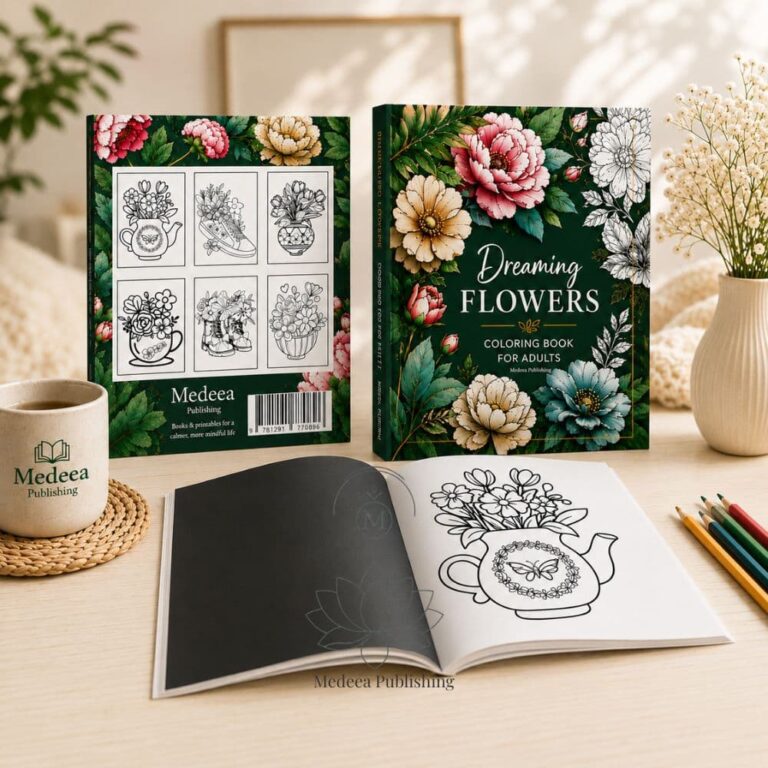
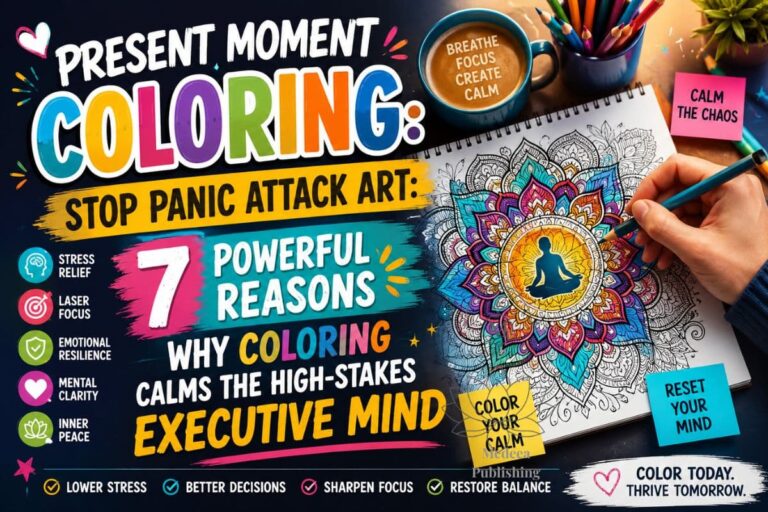
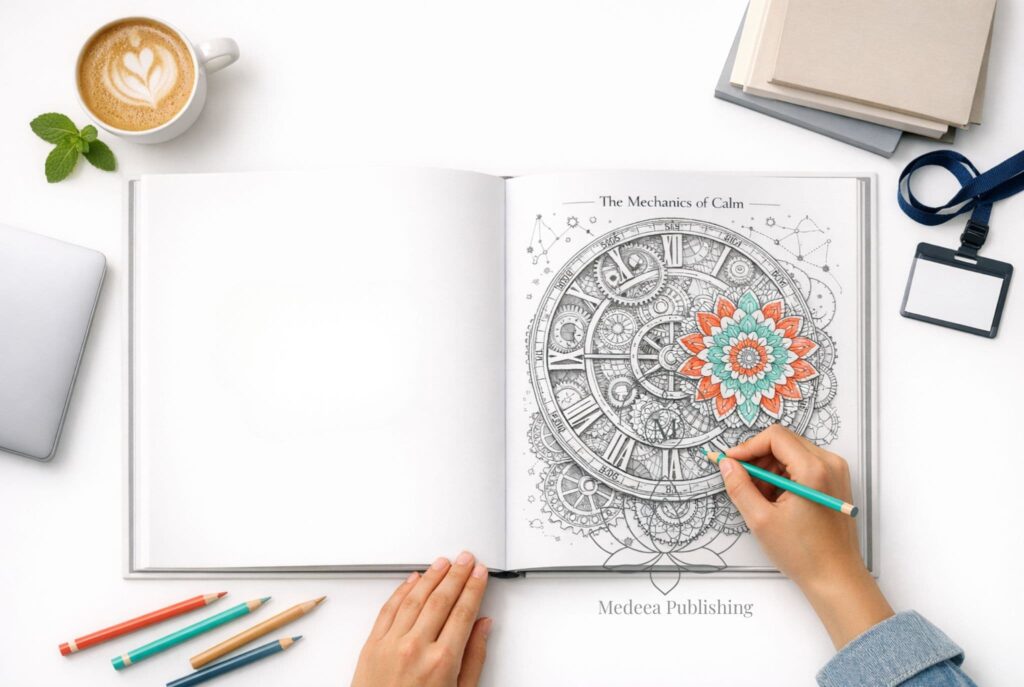
One of the most effective ways to practice mindfulness for anxiety relief is through creative expression. This is why we are so passionate about our work at Medeea Publishing. Coloring is not just for children; it is a form of active meditation. When you pick up a colored pencil and focus on staying within the intricate lines of our coloring book collections, your brain enters a “flow state.”
In this state, the inner critic falls silent. The repetitive motion of shading and the choice of colors provide a soothing sensory experience that redirects the mind away from anxious loops. Our books are specifically designed with patterns that encourage relaxation and focus, making them the perfect companion for your mental health toolkit.
5. Loving-Kindness Meditation (Metta)
Anxiety often comes with a side of harsh self-criticism. Loving-kindness meditation involves silently repeating phrases of goodwill toward yourself and others. Phrases like “May I be safe, may I be healthy, may I live with ease” can soften the internal environment. By cultivating compassion, you reduce the “threat” response that fuels anxiety.
6. Mindful Walking
You don’t have to sit perfectly still in a silent room to practice mindfulness for anxiety relief. For many high-energy professionals, teachers, or parents, the idea of sitting in traditional meditation can actually trigger more restlessness. This is where mindful walking becomes a transformative alternative. It is the practice of turning a simple, everyday movement into a profound anchor for the soul. By shifting your attention from the chaotic “chatter” of your mind to the physical mechanics of your body, you engage in a powerful form of mindfulness for anxiety relief that can be practiced anywhere—from a quiet hallway at work to a bustling city park.
Mindful walking is fundamentally about feeling the solid ground beneath your feet and reclaiming your connection to the physical world. Instead of rushing toward a destination, you treat the walk itself as the goal. Notice the subtle sensation of your heel striking the floor, the rolling transition of your weight across the arch, and the final push-off from your toes. Pay close attention to the gentle, rhythmic movement of your arms and the way your breath naturally synchronizes with your pace. This deep, somatic awareness is a cornerstone of mindfulness for anxiety relief, as it forces the brain to process current sensory data rather than looping through future worries or past regrets.
If you are outdoors, expand your sensory field to include your surroundings, but do so with a neutral, observational lens. Observe the specific shades of green in the leaves, the intricate textures of tree bark, or the slow, drifting movement of the clouds without labeling them as “good,” “bad,” “beautiful,” or “ugly.” Simply witness them. This “label-free” observation is a key skill in mindfulness for anxiety relief, training your brain to witness stressful thoughts in the same detached way you witness the wind. By practicing this during a ten-minute walk, you build the mental muscle needed to remain calm when life’s “clouds” become gray.
Ultimately, integrating this moving meditation into your day ensures that your peace isn’t dependent on a quiet environment. It allows you to carry your sanctuary with you. Whether you are walking to your car or taking a deliberate stroll after a long day of coloring, using these moments for mindfulness for anxiety relief creates a bridge between your internal calm and the external world. You are not just moving through space; you are grounded, present, and entirely in control of your own mental narrative.
7. The S.T.O.P. Technique
This is a quick “reset” button for your day:
- S: Stop what you are doing.
- T: Take a breath.
- O: Observe what is happening in your body and mind.
- P: Proceed with something that will support you in the moment.
This brief pause prevents the accumulation of stress throughout the day.
8. Labeling Your Thoughts
One of the most profound shifts in a mindfulness for anxiety relief practice occurs when you change your relationship with your internal dialogue. Instead of identifying directly with a feeling by saying “I am anxious,” try shifting to a more observational stance: “I am noticing a thought that I am anxious.” This subtle but powerful adjustment in language creates an immediate psychological distance. You begin to realize that you are the expansive sky, while your thoughts and emotions are merely the passing weather—sometimes stormy, sometimes clear, but always temporary. By labeling these mental events as “planning,” “worrying,” “judging,” or “remembering,” you effectively strip them of their power to hijack your nervous system. This objective labeling is a cornerstone of mindfulness for anxiety relief, as it prevents a single intrusive thought from spiraling into a full-blown emotional crisis.
9. Mindful Eating
In our fast-paced culture, we often eat while scrolling through emails, watching the news, or planning our next meeting. This disconnected way of consuming food mirrors the scattered nature of a stressed mind. To enhance your mindfulness for anxiety relief, try to engage all five senses during at least one meal a day. Notice the intricate texture of your food, the complexity of its aroma, and the subtle shifts in flavor as you chew. This practice does far more than just aid digestion; it serves as a rigorous training ground for your brain to focus on one single, physical sensation at a time. This “mono-tasking” is the direct antithesis of the fragmented attention that feeds chronic worry. When you eat with presence, you are reinforcing the same neural pathways used in mindfulness for anxiety relief, making it easier to stay grounded when external pressures mount.
10. Digital Detox and Presence
The constant barrage of digital notifications is a primary trigger for modern stress, keeping our brains in a perpetual state of hyper-vigilance. To create a sustainable foundation for mindfulness for anxiety relief, it is essential to establish “sacred zones” or specific times during the day where technology is strictly prohibited. Use these unplugged windows to engage in a tactile, analog hobby—such as working through a Medeea Publishing coloring page. Replacing the flickering blue light of a screen with the physical resistance of a pencil on a textured page allows your nervous system to downregulate and finally enter a state of true rest. This deliberate shift from the digital to the physical is a vital component of mindfulness for anxiety relief, as it breaks the addictive cycle of dopamine-seeking behavior and replaces it with the slow, steady satisfaction of creative presence.
Why Creative Expression Matters in Mental Health
Humans are inherently creative beings. When we feel stifled or overwhelmed, we lose touch with that creative spark. Engaging in art—no matter your skill level—acts as a bridge back to your authentic self. This is why mindfulness for anxiety relief often includes activities like journaling, painting, or coloring.
At Medeea Publishing, we see our books as more than just paper and ink. They are invitations to slow down. When you choose a color for a flower or a geometric pattern, you are making a low-stakes decision. This empowers the brain, which often feels “paralyzed” by the high-stakes decisions of daily life. The tactile experience of paper and the visual satisfaction of a finished page provide a sense of accomplishment that can boost your mood and lower your stress levels.
Creating Your Sacred Space
To maximize the benefits of mindfulness, try to create a small “nook” in your home dedicated to relaxation. It doesn’t need to be large—just a comfortable chair, good lighting, and your Medeea Publishing coloring supplies. By having a physical space associated with calm, your brain will begin to relax the moment you enter it.
How to Build a Sustainable Mindfulness Routine
Consistency is more important than duration. Five minutes of mindfulness for anxiety relief every day is more effective than an hour once a month. Here are a few tips to make it stick:
- Tie it to a habit: Practice mindful breathing while your coffee brews.
- Be gentle: Some days will be harder than others. That’s okay. The goal isn’t to “clear” the mind, but to notice when it’s full.
- Use tools: Don’t be afraid to use guided meditations or coloring books to help focus your attention.
Finding Joy in the Little Things
Ultimately, mindfulness for anxiety relief teaches us to find joy in the mundane. It’s the warmth of a mug in your hands, the vibrant blue of a colored pencil, or the quiet of the early morning. These small moments are the building blocks of a peaceful life. Anxiety tries to tell us that we aren’t safe unless everything is perfect. Mindfulness shows us that we are safe right here, right now, exactly as we are.
We invite you to explore the world of Medeea Publishing. Whether you are a seasoned practitioner of mindfulness or someone looking for their first tool to combat stress, our collections are designed with your mental well-being in mind. You deserve a life that feels manageable, creative, and calm.
Final Thoughts
Anxiety is a difficult companion, but it doesn’t have to be the driver of your life. Through the power of mindfulness for anxiety relief, you can reclaim the driver’s seat. Start small, be patient with yourself, and remember that every breath is a new opportunity to start over. Pick up a coloring book, take a deep breath, and let the healing begin.
Frequently Asked Questions
1. Can mindfulness really cure my anxiety?
While mindfulness is not a “cure” in the medical sense, it is a highly effective management tool that can fundamentally transform your quality of life. It is important to understand that the goal of mindfulness for anxiety relief is not necessarily to delete the feeling of anxiety forever, but to change your relationship with it. Instead of being a victim to the “storm” of your thoughts, you learn to become the observer. This practice makes the symptoms significantly less intense, shorter in duration, and much easier to navigate when they do arise. For many, mindfulness for anxiety relief acts as a powerful bridge, often used alongside traditional therapy to achieve the most profound and lasting results.
By consistently practicing mindfulness for anxiety relief, you are essentially rewiring your brain’s response to stress. Anxiety thrives on “what if” scenarios—future events that haven’t happened yet. Mindfulness pulls you back into the “what is”—the tangible reality of the present moment. This shift prevents the nervous system from staying in a perpetual state of “fight or flight,” allowing your body to recover more quickly from stressors. Over time, individuals who prioritize mindfulness for anxiety relief report a greater sense of agency; they no longer feel controlled by their intrusive thoughts, but rather empowered to choose how they react to them.
Furthermore, integrating creative tools like Medeea Publishing books into your mindfulness for anxiety relief routine provides a physical anchor for this mental shift. It gives the brain a structured, low-stakes environment to practice focus and calmness. As you fill a page with color, you are training your mind to stay present, a skill that eventually carries over into high-pressure social or professional situations. While it may not “cure” anxiety in a way that it never returns, mindfulness for anxiety relief ensures that when anxiety does knock on your door, you have the strength, clarity, and tools to handle it without losing your inner peace.
The Challenge: The next time you feel a wave of worry, try to name 5 things you can see, 4 things you can touch, and 3 things you can hear. How does this quick mindfulness for anxiety relief exercise change your immediate physical tension? 🎨
2. How often should I use coloring books for anxiety relief?
There is no rigid rule or “one-size-fits-all” prescription when it comes to the frequency of your practice! Because your emotional needs fluctuate from day to day, the best approach is to treat your coloring book as a flexible, always-available sanctuary. Many people find that dedicating just 15–30 minutes to mindfulness for anxiety relief through coloring before bed helps them disconnect from the day’s digital noise and prepares the brain for a significantly deeper, more restorative sleep. By replacing late-night scrolling with the tactile movement of a pencil, you signal to your nervous system that it is finally time to transition from high-alert into a state of rest.
Beyond a fixed evening ritual, others successfully use coloring as a strategic “brain break” during a high-pressure workday. When you feel your focus fracturing or your stress levels rising during a series of meetings, stepping away for even ten minutes of mindfulness for anxiety relief can act as a psychological reset button. This short burst of creativity clears the “mental clutter” and allows you to return to your tasks with renewed clarity and a lowered heart rate. It is a portable, low-stakes way to prevent stress from accumulating into burnout.
The most important factor is to listen to your body and use this tool whenever you feel the need to ground yourself in the present moment. Whether you choose to color for five minutes during a chaotic morning or for an hour on a quiet weekend, the goal of mindfulness for anxiety relief remains the same: reclaiming your inner peace. By making this a consistent habit rather than just an emergency response, you build a resilient foundation that helps you stay calm before anxiety even has a chance to take hold.
3. What if I can’t stop my thoughts during mindfulness?
That is perfectly normal and expected! One of the most common misconceptions about starting a practice of mindfulness for anxiety relief is the idea that you must achieve a state of total mental silence. In reality, the goal of mindfulness isn’t to stop thoughts or “empty” the mind, but rather to notice those thoughts as they arise without getting frustrated or overwhelmed by them. Your brain is designed to think, and trying to force it into stillness often only creates more tension.
Every time you notice that your mind has wandered—whether it’s drifting toward a stressful deadline or a distant worry—and you gently bring your focus back to your breath or the stroke of your pencil on a Medeea Publishing page, you are successfully practicing mindfulness for anxiety relief. This act of “returning” is the actual “bicep curl” for your brain; it is the moment where you build the most mental strength. By repeatedly redirecting your attention to the present moment, you are training your nervous system to remain centered even when the internal or external world feels chaotic. Over time, this makes your anxiety feel less like a commanding force and more like background noise that you can observe with calm indifference.
The Challenge: Try to color for 5 minutes without judging any thought that pops into your head. Just say “there’s a thought” and go back to your color. How does this shift your perspective on mindfulness for anxiety relief? 🎨